This blog was originally based on a course ran by Professor Nick Gray of the Trinity Centre for the Environment at Trinity College Dublin who also wrote a textbook for the module Facing up to global warming: What is going on and what you can do about it. Now working as an independent consultant, Nick continues to work in the area of environmental sustainability and looking at ways of making a difference without recriminations or guilt. Saving the planet is all about living sustainably.


Showing posts with label TCD. Show all posts

Wednesday, April 22, 2015

It’s the 22nd April and it is Earth Day!

Why do we need Earth Day?

Because it works!  Earth Day broadens the base of support for environmental programs, rekindles public commitment and builds community activism around the world through a broad range of events and activities. Earth Day is the largest civic event in the world, celebrated simultaneously around the globe by people of all backgrounds, faiths and nationalities. More than a billion people participate in Earth Day events and campaigns every year. So you need to start celebrating as well!


We are celebrating Earth Day by releasing details of a new book:

Facing up to Global Warming
What is going on and how you can make a difference

The book written by Professor Nick Gray, Director of the Trinity Centre for the Environment at Trinity College Dublin, is based on his course  Living Sustainably: A guide to surviving a changing planet.  The book is to be published by Springer and is due out in the summer.

To find out more about the book look at its website http://www.ournewclimate.com


To read more about the Earth Day movement and its history use the link:  http://www.earthday.org/earth-day-history-movement

Friday, December 5, 2014

World Soil Day - December 5

Land as a Finite Resource

Land is now considered to be a finite resource under significant threat from farming, industry and development.  The basis of land is of course soil which provides us with our food, fodder for livestock, fuel, fibre, building materials, and much more.  It is key to all ecosystem services and to human wellbeing.  Soil also harbours a significant portion of global biodiversity and is a key component in the carbon cycle and the storage and sequestration of carbon dioxide. World soil day has been celebrated each year since 2002 to raise awareness and to support action to protect and enhance soil quality.  The FAO are now the key organizers of events all around the world to celebrate World Soil Day.

Here is a message from FAO Land & Water Division Director, Moujahed Achouri


For more information about FAO World Soil Day contact Professor Nick Gray (nfgray@tcd.ie)

Thursday, May 29, 2014

Ecotourism...creating a positive change

Ecotourism is defined as "responsible travel to natural areas that conserves the environment and improves the well-being of local people." (TIES, 1990)  The International Ecotourism Society is a non-profit organisation with members in over 120 countries. They promote awareness of sustainable practice in the tourism sector, and provide guidelines on standards, training, technical assistance and educational resources. In the decade between the Earth Summit in 1992 and the International Year of Ecotourism in 2002, a web of over 100 certification and award programs appeared, (most of which are of varying quality).

The World Ecotourism Summit (WES) is organized by UNEP and the World Tourism Organisation (UNWTO) aiming to strengthen ecotourism as a tool for sustainable development and conservation. Separately, the World Ecotourism Conference aims to provide a networking platform for businesses and policy makers, but with little apparent impact. The European Ecotourism Network (EEN) and the European Ecotourism Labeling Standard (EETLS), which is co-funded by the European Commission, has been recognized by the Global Sustainable Tourism Council (GSTC) and in comparison with WEC and WES, there is more focus on certification and standardization. However, there is no single ruling body for global ecotourism certification, and this has inevitably led to considerable controversy and uncertainty. As it stands, the GSTC appears to be the most credible.
The Green Globe Standard was one of the leading certification bodies to come out of the Earth Summit in 1992 and is based on the following international standards and agreements: GSTC, Global Partnership for Sustainable Tourism Criteria (STC Partnership), Sustainable Tourism Certification Network of the Americas, The ISO 9001/14001/19011 (International Standard Organization) and Agenda 21. EcoAustralia, in conjunction with Green Globe, has proven to be a successful international standard and has also employed in India.

Basic ecotourism principles:
  • Sustainable management e.g. design and construction, health and safety and communications.
  • Socio-economics e.g. supporting local community initiatives such as education, fairly traded goods and securely integrated local employment.
  • Cultural heritage e.g. protection of historical, archaeological and spiritual sites and respectful incorporation of local culture.  
  •  Environmental e.g. sustainable management of water, energy, waste and protection and awareness of biodiversity.


Case Study – Lapa Rios Eco-lodge, Costa Rica
In 1993, a professional couple from Minnesota liquidated their assets and bought 930 acres of rainforest in the south west of the country. In 2013, they signed an agreement endorsed by The Nature Conservancy and CEDARENA that perpetually protects the land as a primary forest. It neighbors a National Park, which is home to 2.5% of the world’s biodiversity and acts as a migration corridor.

Although Lapa Rios eco-lodge is a leading example of ecotourism, it has not been certified by organisations such as Green Globe. Instead, they are certified by the Costa Rican tourism board agency known as the Certification for Sustainable Tourism (CST), following similar principles outlined above. The CST has been recognized and approved by the tourism ministries in every country in Central America, as well as Mexico, Belize and many countries in South America have expressed interest in developing similar programs. Learn more about Lapa Rios here.


It is evident that ecotourism can and does create real positive change, even when it operates outside of well-intentioned conferences, however, many resorts will often use it as a buzzword to attract gullible travellers, so beware!
Conor Dolan

Thursday, May 15, 2014

Eating Insects To Save The World, Don’t Let It Bug You!

Source: http://www.ibtimes.com/cupcakes
-made-insects-food-thought-photos-555117
Minestrone with buffalo worms and mealworms (grasshopper garnish optional); termite porridge; ‘land shrimp snack’ made of grasshoppers or locusts with hot pepper oil, lime and salt and protein bars made with cricket flour. These are just a handful of recipes from “The Insect Cookbook: Food For a Sustainable Planet” published by Dutch entomologists Arnold van Huis and Marcel Dicke, along with cooking instructor Henk van Garp[1]. The books main aim is to open our eyes to the fact that our aversion to insects as a food source is senseless and outdated. Unlike livestock and other forms of animal protein, insects are plentiful and nearly everywhere. Whilst, culturally we tend to overlook the possibility of caring for ourselves by insect means, they are a nutrient-rich and sustainable food-source that deserve consideration.

Jon Foley, head of the Institute for the Environment at the University of Minnesota, recently referred to the global food crisis as ‘the other inconvenient truth’ stating that he believes we are at a ‘critical crossroads’. Currently, the population of the world increases by about 75 million people each year. According to the United Nations Panel on Global Sustainability, the world will need at least 50% more food and 30% more water by 2030[2]. As developing countries adapt to modern needs and their economies grow, their demand for meat will increase and to meet this we will need to triple our food production. Unfortunately with current agricultural practices this is an impossible goal.

Source: http://finedininglovers.cdn.crosscast-
system.com/ImageAlbum/3216
/original_694-a.jpg
A recent report issued by the U.N.’s Food and Agriculture Organization (FAO) promoted human consumption of insects as an environmentally sustainable means of feeding the planet. Although it was met with disgust and tossed aside by many, others such as food expert, Ruth Reichl, former editor-in-chief of Gourmet and award winning author recently told the New York Times that “We should all be eating insects, and we all will be eating insects. They are a perfectly reasonable source of protein.”   Like it or not, eating insects (or entomophagy) provides a far more sustainable source of protein than our existing consumption of meat and animal products. Also, most edible insects are very protein rich while being comparatively very lean. For example, a cricket has all the essential amino acids that beef contains but is far higher in iron and calcium. Other insects can provide other micronutrients such as B-vitamins, beta-carotene, and vitamin E.

Not only are insects often more nutritious but they are also a potential solution to the current inefficient food system because of their marginal environmental impact. In general, insects are extremely inexpensive and relatively safe and only require a fraction of the feed, space, water and maintenance of conventional livestock. The current livestock industry is estimated to be responsible for 17-18% of greenhouse emissions and accounts for 70% of all land cleared for agriculture[3]. Almost half of global water is used to produce animal-based foods. Insects, on the other hand, can live off agricultural byproducts such as food waste (e.g. fruit peels) and only a tiny portion of them produce methane, with those that do only producing very small amounts. Also as insects are poikilothermic (i.e. their body temperature remains the same as their surroundings), they are much more efficient at converting nutrition into protein. For instance, crickets need 12 times less food than cattle to produce the same amount of protein and unlike the cruel practice of factory farming, crickets and other bugs actually thrive when they are packed on top of each other[4]. Convinced yet?

With an estimated 1417 species of insects being regularly eaten by over 2 billion people across 3,000 ethnic groups in 80% of countries around the world, it seems it is the Westerners who will suffer most in the long run. But why are we so squeamish when it comes to the idea of chomping down on nice slice of crittle (a cricket and peanut brittle hybrid)?

Most of the Western world readily eats prawns and shrimp, which are arthropods-just, like insects, spiders and millipedes! Therefore, we need to get over this idea that insects are disgusting and stop trying to live in an insect-free world where everything is sterile and clean (after all we wouldn’t be here without the pollinating insects!). But before you get too excited and run down to the local park with a homemade pooter, take heed of the following advice. Like plants, some insects are good for you and some are toxic, aswell as the fact that you can never be sure that wild insects haven’t been exposed to pesticides, therefore, only farmed insects should be consumed. There are also several ‘pestaurants’ opening up around the world with a variety of insects to suit every palate. Experts also caution that we must be careful to develop sustainable cultivation and harvesting methods, as there are examples of human overconsumption that has led to the collapse of some insect species.

Jakub Dzamba, a man who’s researching radical approaches to urban agriculture, is working to build insect farms that can go right into the walls of an apartment building. The idea is that families could feed their food scraps and leftovers to the crickets, and then eat those same crickets, thus solving the dual agricultural problems of production and distribution.  It would therefore seem that these six-legged critters might just find a spot at our table in the not-so-distant future. If we can just start to accept and overcome our fear of munching on food that creeps and crawls, the future looks a little brighter for us humans. Unfortunately, I’m not so sure the same can be said for the future of our possible new food source, who have more of a reason now than ever, to stay away from the ‘light’!

Thursday, May 1, 2014

Trinity College Dublin participates in first Intervarsity BioBlitz

On 1st and 2nd of May four teams of scientists, in four different universities, will race against time to see how many plants and animals can be recorded on their campus in a 24-hour period. TCD is one of four universities taking part in the event, which also includes DCU, NUI Galway and UCC.
But anyone around campus can join in by visiting the BioBlitz Public Lab upstairs in the Science Gallery. The Lab will open at 9.30am on Friday, 2nd of May and provides a great opportunity to meet the scientists involved and find out about the plants and animals that inhabit the TCD campus. Visitors can join in one of three different plant walks at 9.30 which will survey TCD’s gardens, or find out about bugs, birds and moths at the Lab.
One of the key aims of BioBlitz is to raise awareness about biodiversity. As part of the TCD BioBlitz public engagement programme 4th class from St. Mary’s Boys school will visit the Gallery for a workshop on pollinators with Green Bee Education (www.greenbeeeducation.com). The class will make nests for solitary bees which will positioned around campus and will be revisited with a primary school class at next year’s BioBlitz.
Students and staff are being encouraged to get involved by raising awareness of Irish wildlife and the BioBlitz event through social media. Different species flyers created by @daveendangered have been distributed across the campus with specific social media contact details. This is an opportunity for everyone to support the BioBlitz and get involved by creating a SpeciesSelfie through e-mail, twitter and facebook.
For more information about the BioBlitz or how you can get involved please contact Dr Rachel Kavanagh at tcdcbr@tcd.ie.

Visit the Science Gallery on Friday, 2nd May to join in the fun.

The BioBlitz is an initiative of the National Biodiversity Data Centre and An Taisce Green Campus.  This initiative is supported in Trinity College by Trinity Centre for Biodiversity Research, the School of Natural Science, The TCD Green Committee and the MSc students in Biodiversity and Conservation and Environmental Science.

 Dr Rachel Kavanagh

Tuesday, April 22, 2014

Earth Day 2014

Earth Day is an annual event celebrated each year on April 22nd where events are held to support a sustainable world.  Started in 1970 by John McConnel, a peace activist, and Gaylord Nelson, a US Senator, Earth Day celebrates the first day of spring in the Northern hemisphere by inviting individuals and groups from around the world to get involved.  Link


Each year there is a new focus and this year’s theme is Green Cities.  Climate change fuels migration into cities where well over half of our global population now resides…this means that cities will have to adapt and evolve as they grow.


Nick Gray

Monday, April 7, 2014

Ignorance is Bliss, but Knowledge is Power – the importance of education in the move towards sustainable living

I had always considered myself a relatively ‘eco-friendly’ person, enjoying time spent outdoors, despising litter and pollution, growing up in a countryside household that values the environment. I reassured myself that by recycling plastic bottles, walking short distances and by availing of public transport as opposed to driving a car that I was able to justify endless of television and laptop use, recreational shopping and an occasional flight to Europe for a holiday in the sun. In recent years I have since come to accept that I can no longer engage in the same consumption practices of the past without a sharp pang of guilt. The ‘you-should-know-better’ voice inside my head (that developed as a result of four years of environmental and sustainability-related lectures) now lingers when I queue to pay for a heavily packaged pair of shoes, or a box of fruit that has been transported thousands of miles from its source of origin. Education has indeed opened my eyes to the reality of my contribution to increasing carbon emissions and the associated consequences.

As suggested by the title of this blog, to me, ignorance was bliss. Although I was aware that my energy consumption practices far outweigh those of people my age in other parts of the world, it was a thought that rarely crossed my mind. Thus, for several years I was blissfully engaging in the unsustainable mass-consumption economy I was born into. Taking a rather Orthodox Marxist perspective, I would argue that the environmental issues at hand today are inherently interlinked with this capitalist system and that the current crisis of the situation necessitates a demand for scientific, technological and other developments to improve our current understanding and the methods employed for resolving these issues. This information then needs to be distributed to and understood by people of all ages, across all levels of society, in both the public and private sector. In short, we need education.

As my awareness of the extent of the global environment issues grew, I must admit the temptation to adopt a despondent, existential attitude was there – after all, given the magnitude of the situation, if nobody else was making changes what difference could I make? However I ultimately believe that knowledge, particularly knowledge pertaining to the effects of an individual’s lifestyle and personal choices, has the ability to empower and inspire meaningful action. The role of education in this regard has become increasingly recognised by actors and organisations across multiple spheres. Departments of Education worldwide and multinational organisations such as UNESCO and the WWF run programmes in support of sustainability-based education. Such courses aim to promote sustainable lifestyle choices and often take a particular focus on the education of younger generations. In August 2013 for example, the Irish Department of Education and Skills launched a plan to develop the ‘National Strategy onEducation for Sustainable Development in Ireland’. This strategy expresses the significance of education. It aims to establish sustainable development learning at all levels of the education system and to promote public awareness and create support for education for sustainable development. I strongly believe the implementation of such strategies, as part of a wider movement that recognises the importance of education, is the first step in the long road to sustainable living.

Claire Quinn

Further information:
Nevin, E., 2008. Education and sustainable development. Available at: http://www.developmenteducationreview.com/issue6-focus4
Journal of Education for Sustainable Development, 2013.  Available at: http://jsd.sagepub.com/

Friday, March 28, 2014

Eco Living, Ahoy Mate!


The idea of living in an 8 by 20 foot steel box is enough to get you a few raised eyebrows and ‘are you mad?’ comments. But what if that box was spacious, homely, fully transportable, cheap, fire and flood proof, fully functional and designed to your own taste whilst keeping your ecological footprint to a minimum? If that sounds a bit better than maybe you are in the market for the latest green home, a converted shipping container.
http://ecovidainternational.com/eco-design-and-construction/
can-you-build-with-shipping-containers-in-spain/

Taking reuse to a new level there has been an upsurge in the use of old, disused containers in to modern, quickly assembled and environmentally friendly homes throughout the globe. It has been estimated that there are up to 24 million containers that will never be used to transport cargo again and not only do these make great temporary homes for those in crisis (they were used as emergency accommodation for people after the 1988 earthquake in Armenia) they also make excellent contemporary office and living space (there’s even one down the road from me being used as stables!). One important aspect is that they are cheap to acquire in the first place. A quick scan of buyandsell.ie shows some for sale for as little as €1,600 + VAT.
The fact that these homes are making use of a discarded material already makes them smart ecologically but many of them have incorporated features to make them that bit more sustainable. Some containers sport solar panels angled on the roof and others have small wind turbines and energy efficient windows. Another eco-friendly aspect it that it takes very little time for the setup of these homes which facilitates less disturbance to nature and also that they are transportable meaning they are not permanent in that area. Timber is also not required in the way that it usually is for many other house builds. One company has designed an ‘ecopod’ container to show just how sustainable you can make them. The ‘ecopod’ has recycled flooring, a solar powered fridge, a compostable toilet, wall sockets and 12v lighting that is powered by the roof mounted solar panel.

http://www.designtopnews.com/architecture-design/greentainer-eco-fied-
container-architecture/

If you think you need to compromise on the design aspect of the house in order to gain all these benefits think again. The containers can be piled high on top of one another, or fused together creating a manipulated masterpiece. They can be changed past the point of recognition or left in their original state bringing an urban renewal feel to the place there are also ones designed to disappear in to the natural background. The architectural possibilities are endless once you remember to think outside the box (a steel one in this case!).

Have a look at the links below if you want to see some globally inspiring uses of containers from skate parks to student housing: http://www.popularmechanics.com/home/shipping-container-homes-460309#slide-1


Saturday, March 15, 2014

The Potential of Geothermal Power


The development of more sustainable, cleaner and cheaper sources of energy is being driven by the depletion of fossil fuels and their impact on our environment through release of greenhouse gases. Geothermal energy is one of these upcoming new sources that today is relatively untapped but its potential can be seen in countries such as  Iceland where 25% of its electricity and 90% of its heating is obtained from geothermal power.[1] This energy is derived from the thermal energy beneath the earth's surface that resulted from the original formation of the earth as well as the radioactive decay of elements uranium, thorium and potassium. On average one kilometre of depth corresponds to a rise in temperature of about 20oC. The temperature inside the earth melts rock and also heats up water trapped in cracked and porous rock to create geothermal reservoirs of hot water and steam. Geothermal power plants rely on these reservoirs to harness the heat energy to produce electricity by drilling deep wells into the earth and piping steam or hot water to the surface and using it to drive generator turbines.[2] This water is then piped back into the reservoir through injection wells to be reheated and thus with careful management to maintain the viability of these reservoirs  makes this process of obtaining energy, sustainable. Geothermal power plants emit approximately 1% of the sulphur dioxide, <1% of the nitrous oxide and 5% of the carbon dioxide that is emitted by a similar sized coal-fired power plant.[3] Geothermal energy has an advantage over other renewable energy resources such as solar or wind energy in that it can provide us with  a consistent and more reliable supply of power. There was 8,933 MW of installed capacity in 24 countries with geothermal power plants in 2005 and this has risen by almost 20% to 10,715 MW which generates 67,246 GWh/year  in 2010 according to a report by the International Geothermal Association.[1]               

The United states leads the world in the production of geothermal electricity with an installed capacity of 3,086 MW which is equivalent to the electricity obtained from burning 60 million barrels of oil.[1,4] This 3,086 MW relates to only less than 0.5% of the United states total electricity usage and shows how much of an untapped resource it is today. However there are a few problems that need to be overcome to promote the development of geothermal power plants. One of these problems is the high costs of drilling wells which can be between $2.3-4.0 million for a depth of 1500-3000 meters.[5 ]Another problem is the limited areas in which the conditions are suitable, which was normally  an area near the boundaries of tectonic plates. Although this problem is currently being resolved with the development of Enhanced Geothermal Systems technology that allows us to create our own geothermal water reservoirs. With most governments know realizing the effects of green house gases on our environment, geothermal energy will definitely be considered as a potential sustainable energy resource and may even be considered better option in countries such as Ireland where the development of a nuclear power plant will most likely be met with a large opposition.

Michael Rooney


Thursday, March 6, 2014

Recycled Art


The other day, while heavily procrastinating in order to avoid learning about Newton’s Laws of Physics, I came across an image when perusing my Instagram feed that grabbed my attention. The image was created by an artist known as Erika Iris Simmons who specialises in creating art using non-traditional media. This particular piece of art was a portrait of Michael Jackson and was produced using the inside reels of a cassette tape. I was honestly astounded by how recognisable and precise it was but the fact that it was made from such an accessible household item is really what got me thinking.

I proceeded to Google search ‘Recycled Art’ and was, again, blown away by what I found. More masterpieces including a chicken made from egg shells, a collage of a young boy made from newspaper clippings and even a portrait of Barack Obama made from old buttons and brooches greeted my laptop screen. Now don’t get me wrong, I know what you might be thinking. But I can assure you that I am not some kind of an art junkie who finds beauty in everything. The fact I am saying that this type of art is cool is definitely saying something! So, with further examination of the different sources of Recycled Art on the internet, I discovered an article on its benefits which again sparked my interest. I had not realised there were any benefits until I read this article which is my reason for sharing it in this blog post. I feel more people need to become aware of this amazing form of art that has been revealed to me and I’m going to try and expose it to you too while you’re here!

Anyway, in this article outlining the benefits, they talked about how using household items in art is not only
a fun thing to do but it also reduces your energy consumption. So let me ask you this: when you throw something into the bin, do you think about where it’s going? All waste must go somewhere; be it a landfill, incineration centre or a recycling centre. Classic recycling may be better than all waste being dumped into a landfill but that doesn’t mean it has a positive effect on the environment. It still consumes not only space but also man power and money. These types of artwork take all the non-toxic junk and make useful items out of them which gives something back to both the environment and the economy.

But, the prime benefit we can acquire from this is that it saves a lot of energy. The re-production of recycled materials always requires consumption of new resources which in turn, results in more pollution and less resources. By adopting this strategy of reusing household junk, we are minimizing the energy spent on new production which directly impacts positively on climate change.

So, if you’re in any way artistic (or even if you’re not!), why not try dabbling your hand in Recycled Art? It’s fun, unique and most importantly, eco-friendly. I’ll make sure to share a new blog post with you guys showing my attempts. Don’t hesitate to share yours in the comments below. ‘Til next time, happy sustainable living!

Aoife Mullally

Image Sources:
Image 1: http://www.hongkiat.com/blog/recycled-art-masterpiece-made-from-junks/
Image 2: http://www.wikihow.com/Live-a-More-Environmentally-Friendly-Lifestyle
Image 3: http://www.corvallisadvocate.com/2013/0131-corvallis-landfill-filling-up/

Tuesday, January 14, 2014

New look for Our New Climate website

Even in a remote part of rural Ireland you are never far away from contarils
Another year and another start to the Broad Curriculum course Living Sustainably.  This year we have altered the format of the website ournewclimate.com and hope to expand it further to support the course in a more direct way.  This year the 84 students on the course will be producing a wide range of exciting and challenging posts for the blog.  This year will also see the publication of a support course textbook for the course as well. So it’s going to be an exciting 2014.

Nick Gray

Sunday, November 17, 2013

Energy saving in public buildings

The Friends of the Earth have suggested that massive cuts in emissions as well as financial savings could be made by adopting more rigorous energy saving in schools, hospitals and other public offices.  It especially highlights buildings that are heated when empty during weekends and leaving computers switched on when not in use.  It estimates that it could save the state 1.75 billion euro over 10 years and  calls for  retrofitting such buildings with better insulation, reducing dependence on air conditioning and using low carbon heating systems. However, small changes can make a difference. A school in Clara in County Clare was able to reduce its electricity usage by 70% by simple actions such as lowering the heating setting on the central heating, using  time switches for heating rooms that were not used all the time, turning off the boiler at night and weekends, and encouraging staff and pupils to close doors and turn off lights.  Plans are already in place by the Government to reduce electricity use in over 10,000 buildings run by central and local government under the National Energy Efficiency Action Plan. It is claimed that the plan has already reduce energy usage by 33%  across the public sector.

More information: Friends of the Earth (2013) ‘Cuts that don’t hurt’. Friends of the Earth , Dublin. 

More information: The Second National Energy Plan launched in February 2013. 

Nick Gray

Wednesday, October 16, 2013

Ireland's Greenhouse Gas Emissions 2012

Ireland's greenhouse gas emissions rose by 1% in 2012 to 57.92 million tonnes, reversing a six year downward trend.  This was primarily due to a 5.9%  increase in emissions from power generation using coal and peat, and a 3% increase from the agricultural sector due to increased livestock numbers.  Industrial and commercial emissions rose by 1.8% overall, although the cement industry alone showed a 18% increase in emissions as the economy begins to recover. Transport, residential and waste emissions all fell by 3.5, 5.9 and 2.7% respectively. The reduction in residential emissions is thought to be due to the mild winter while the reduction in waste emissions is due to a 11.7% reduction in methane emissions from landfill sites.

EPA emissions by category 1990-2012. Image.

The EPA has blamed low carbon prices for the increased use of peat and coal for electricity generation and has  called for the decoupling of carbon emissions from economic growth.

For a full news briefing: Link

Explore the full Report: Ireland's Greenhouse GasInventory 1990-2012

Nick Gray


Friday, June 14, 2013

Learning from the Dutch cyclists – another important lesson

Learning from the Dutch cyclists – another important lesson
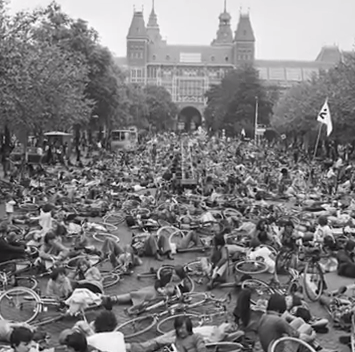
Mass cycling protest in Amsterdam
http://www.brainpickings.org/wp-content/uploads/2012/01/dutchbikes.png
The Netherlands is famous for its cycling infrastructure and policy. In light of climate change and the push to engage in more sustainable lifestyles, cities across the globe have been turning to the Dutch cycling model and trying to integrate its elements into their own sustainability/transport plans and policies. The Dutch cycling culture of today; however, is certainly different than it was in the past.
In the years after WWII, automobile usage skyrocketed following the rapid rebuilding of a war-torn country. Congestion of city streets and marginalization of cyclists quickly became apparent, but one of the most terrible effects of this shift towards automobile use was the number of accident-related deaths of children (400 in 1971) that occurred (1). Mass protests, notable the “Stop Child Murder” campaign became popular, and public pressure to create safer, more cycle and pedestrian friendly streets ensued. Finally, changes in policy and planning were generated at the government level with amazing results. Child deaths were significantly reduced, many city centers became car-free, and infrastructure changed dramatically to reflect the high priority of cyclists visible in Dutch cities today.
While I could write a whole other blog post on the successes (and failures) of learning from and implementing similar cycling models in other cities, I have chosen to highlight another lesson we should be reminded of from the Dutch experience.
The shift from the popularity of the automobile towards a more sustainable means of public transportation was achieved through protesting and public pressure on the government. What alarms me is that the main driver of these protests was the loss of life. It appears as though the 3,300 accident-related deaths in one year (1) was what it took for the public to finally rally together and effect change.
When I think about the heaps of changes that need to be made in our current lifestyles to live more sustainably, I wonder what it is going to take before we get that critical mass of people that can influence our government to help us make these changes on a large scale. There is an overwhelming amount of advocacy groups, initiatives and campaigns geared towards aspects of sustainable living – could any one of these be the next “Stop Child Murder” campaign and cause a great shift towards another element of sustainable living? It is my hope that we can be proactive, that we can stand behind movements to help them reach that critical mass, but that this can be done before we begin to see such severe, direct consequences such as loss of life. Let us learn not only from the fantastic example that the Dutch sets on sustainable transportation, but also from the way this change was effected.
Heather Stark

Saturday, June 1, 2013

My Carbon Cycle

The daily commute is something most people dread. Living in Glenageary and spending 5 days a week in college in the city centre, I spend approximately 90 minutes a day on buses (if I’m lucky and dodge the traffic!) which amounts to a whopper 450 minutes a week sitting on an over-crowded bus listening to other peoples music bleeding from their headphones. It’s time I loath to waste, but it’s not just time that I’m wasting.
My bus journeys make me accountable for about 20km of CO2 production weekly! Inspired by the clearing of the rainclouds and the signals that we may actually begin to experience something resembling Spring, I set myself what seemed like an achievable task: to forgo the buses for a week and instead cycle to college for the week. It seemed like a win/win situation: I’d be using a carbon neutral form of transport and I’d be saving on bus fare. “Why doesn’t everyone do this?” I asked myself as I set off on a crisp March Monday morning.
“Why doesn’t everyone do this?”

About an hour later, as I arrived panting into college, feeling like my legs were about to burst into flames, I found the answer to my own question: This is hard! Every tweak we make to our lives to make them more sustainable requires us making sacrifices.
I believe, in the developed world we are so accustomed to a plethora of amenities and indulgences which work their way into becoming part of our day-to-day lives. Removing even the smallest of these from your routine, is a huge shock to the system. It’s a change that can take a huge amount of adjustment to our daily routine and an element of sacrifice. Therefore, people living comfortable, perhaps financially sustainable lifestyles just simply can’t be bothered. Why go without when making a sacrifice which results in decreasing your carbon footprint puts extra strain or discomfort in your life when the benefits cannot be immediately seen?
It is an uphill battle that environmentalists face: convincing those so consumed with the present that they are directly contributing to the destruction of our future. The allure of immediate gratification is hard to compete with, however we must persevere and accept that seemingly small individual sacrifices now amount to huge collective benefit in the future.
This is a lesson I’ve heard many times, but only really rang true with me when I decided to make a personal sacrifice for the good of the environment in which I live. Taking the bus was by far the easier, passive option. But I had to ask myself, can I afford to knowingly be that selfish and not feel guilty? The answer was no. I’ve persevered with the cycling with some exceptions here and there (there’s no accounting for torrential downpour!) and have willingly made an achievable sacrifice for the greater good. Not to mention the bus fare I’m saving!
Stephen Lehane

Thursday, May 2, 2013

Maybe creating an army of mini Eco Warriors can help?

Image by Art Revolution
The picture says it all, we talk so much about leaving a better planet to our kids, that we forget about leaving better kids to this planet. With our climate recently becoming more and more unstable, there seems to be a lot of concern and general talk about the environment. Phrases like ‘global warming’ and ‘sustainable resources’ are appearing more frequently in the media, so much so that we no longer take much notice of these articles.
Should we really be paying more attention to these issues though? Becoming desensitised to these common phrases isn’t going to make the problem go away now and it never will. It is our responsibility, whether we wish to acknowledge that fact or not, that this is our planet and what happens to it and its vital resources is down to us. But what can we actually do?
Reduce, reuse, recycle? Yet another common phrase often recited in response to questions about protecting the environment, which has lost its meaning for a lot of us. What about education as an answer? Education never seems to be brought up in relation to protecting our planet. We only end up learning about environmental issues when we already have bad habits in our daily lives. Driving to the shop that’s less than a mile walk away, throwing out plastic bags instead of reusing them or bringing your own bag shopping, leaving the tap running when brushing your teeth or washing up after dinner and buying way too much food in the weekly shopping, thinking that you’ll eat it all. Sound familiar? We all do it. We get to this age, living on this planet, using its resources without care like they’re never going to run out, purely because we have never had cause to worry before and because we didn’t know the bad effects our behaviour can have on the environment. It’s not down to ignorance that a lot of us young people have such environmentally unfriendly habits; it’s down to a lack of proper education around the topic.
Maybe if we had been better educated about the environment and its decreasing resources from when we were little, we would have different habits and different views now, at this age. It wouldn’t be a case of having to try and change how we live; more that we grew up being contentious, saving resources and trying to protect and appreciate the environment around us. I don’t mean to try and turn kids into mini eco warriors; I mean to better educate them earlier about what’s actually going on in the environment. What are the resources we need to be worrying about? Which resources are running out and what are the more sustainable options? Maybe try and make things like recycling and water conservation normal everyday things rather than a bonus, which is how they’re seen now.
Maybe if parents stopped worrying about infections and cuts and bruises and threw their kids outside during the summer to enjoy nature and have fun outdoors rather than letting them stay stuck inside playing with plastic toys and expensive electronics which are causing even more damage to the environment. Maybe if nature actually meant more to us from when we were little, we would be more bothered about getting out and doing something about environmental issues rather than sitting inside reading about and talking about global warming and sustainable resources on our smartphones and laptops.
Katie Smith

Photo reference:
Posted 24th September 2012 by Art Revolution
Labels: Anonymous Art


Friday, April 26, 2013

Recycling and My Sandwiches

Recycling is one of those things that, in my experience anyway has been drilled into me from a young age. It is something that as I grew older I became complacent with. I went to a primary school which had a green flag and a secondary school which had a strong recycling policy. I won’t sound very academic when I say this but I never really questioned any of it I just recycled because I was told to and admittedly was a bit scared of the consequences if I didn’t. Putting your yoghurt pot in recycling the bin seemed like an easy alternative to a detention.

Now that I am in college and have left all the fear behind I have continued to recycle out of habit but it was only really when I started the living sustainably course that I began to assess what  impact  recycling  can have.  Just looking around college, we as students are producing a lot of waste. I know for me any way I would throw my drinks bottle and paper wrapper from my roll straight into the nearest bin, whether it be recycling or not. Generally speaking it is not!

One of the tasks on this course was to examine the contents of a refuse sack at home.  I live in my family home so as a whole we would produce more waste than the average group of students living in rented accommodation.  This was a seemingly basic task, I remember doing the same in primary school and proceeding to harp on at my mum for her lack of awareness about all things green.  This time I was approaching it in a new light with the understanding that we as a community of inhabitants of the earth really do not look after what we’ve got.

On examining the bin I found a number of things and I have mentioned this in my assessment. Firstly, the general waste bin I found cling film and then aluminum foil. These are both very commonly used household products. Even for those who but lunch when they are in college many sandwiches are wrapped in such packaging.

This may sound silly but I wasn’t sure whether or not these could be recycled. I took it upon myself to check. (This course really has made me interested in the world around me!). It transpires that cling film cannot be recycled everywhere and neither can aluminium foil.  I was shocked at this! Cling film is something that I would have always choses over aluminum foil simply because I believed it would be recyclable and more ecofriendly than aluminium. I’ll admit, this seems like a very small and insignificant discovery but if it were not for this module I wouldn’t have checked.  So my answer is to get a lunch box.

Although a tiny thing I am now more aware of the small changes I can do to avoid contributing to landfill. Something as small as what I chose to wrap my sandwiches in everyday.

I realize I have picked up on a very small issue however out of the whole module I feel it is one thing in particular that felt very relevant to my life and I felt it was something I could deal with straight away.

Naomi Gibson

Sunday, April 21, 2013

A Greener Trinity Ball?

Trinity Ball is clearly the most anticipated and famous night in our college calendar. With 7,000 students eagerly awaiting this prestigious event, the logistics and running of such an event are often forgot about. With all the hype, it is easy to forget about all the emissions caused by such an event. The hundreds of lights, world class sound systems and the five different stages all contribute to what can only be imagined as a rather large contribution to Trinity’s CO2 emissions. In this blog I will examine a number of eco-friendly festivals and see whether their initiatives could be implemented for the Trinity Ball.

World-renowned music festivals such as Glastonbury and Coachella have become famous, not only for the festival itself, but due to their ability to provide a rather eco-friendly and sustainable festival. They have both adopted a “no trace policy”, which ensures any waste generated at the festival is optimally recycled. Coachella has also become famous due to its solar powered DJ booths. At Portugal’s bi-annual Boom Festival where “biodiesel, solar and wind energy powered 25% of the festival, sustainable bamboo construction techniques literally took center stage” . However it is clear that these festivals are on a much, much larger scale than that of Trinity Ball.

So what could be done at Trinity Ball? Small and creative ideas can be implemented to help reduce its carbon footprint. Something that I feel could be easily implemented is that off providing only organic food produce at the number of food stands. Another idea that could be introduced is one that is similar to what was in place at the former Oxegen music festival. There aim was to reduce the amount of plastic cups that were used at the festival. A pint of beer at Trinity Ball costs 5 euro. My suggestion would be to charge the five-euro for your first pint, and if you return with the same plastic cup, your next pint would see maybe a euro reduction in the price. This would encourage people to keep their plastic cups rather than flinging them on to the ground. This would, I feel, have a significant impact on the amount of waste reduced. Changing the energy sources to a more eco-friendly source would also be a viable option available to the organisers of Trinity Ball. Even something as simple as a pledge by the organisers to ensure that all of the waste is taken care of with the highest diligence is something that would make for a greener festival.

Even small steps towards a greener ball will be something that would be met with great enthusiasm not only by the organisers but also by the college as a whole. If anyone has any other suggestions, big or small, feel free to leave them in the comments section.

Kevin Mateer