This blog was originally based on a course ran by Professor Nick Gray of the Trinity Centre for the Environment at Trinity College Dublin who also wrote a textbook for the module Facing up to global warming: What is going on and what you can do about it. Now working as an independent consultant, Nick continues to work in the area of environmental sustainability and looking at ways of making a difference without recriminations or guilt. Saving the planet is all about living sustainably.


Showing posts with label Nick Gray. Show all posts

Monday, July 29, 2019

Earth Overshoot Day #MoveTheDate


Of all the indices available to measure our impact on Planet Earth it is Earth Overshoot Day  (EOD) that provides a unique insight in to how well we are dealing with the problem of global sustainability.  


Earth Overshoot Day  is the date each year that our collective consumption of resources exceeds the capacity of our planet to regenerate them.

The concept was devised by the research organization  Global Footprint Network  who use their vast database to calculate the EOD for each country as well as a global date which this year is July 29th.   Although started in 2006, they have been able to back calculate the EOD since our planet first fell into ecological deficit in 1970 (data.footprintnetwork.org).   The good news is that the date has stabilized, but we need to get that date going back towards September as quickly as possible and ultimately back to December. The last time EOD fell in December was 1972!  


If we all lived the same lifestyle as those in either the USA or UK then Earth Overshoot Day would fall on March 15 or May 17 respectively. 


#MoveTheDate

We all know that moving towards a sustainable planet is critical in our fight to stabilize climate change as well as to protect biodiversity, prevent hunger and improve planet health and that of ourselves generally.  The Overshoot Organization  has launched the #MoveTheDate campaign giving reliable and achievable advice on how we can all make a difference.  Their goal is to move Earth Overshoot Day back by five days a year so that by 2050 we will have a sustainable planet once more.  So please support their work and make a difference every day in your own life, at home, in the workplace and within the community.


Friday, October 16, 2015

World Food Day


Today is World Food Day which highlights the urgent issue of chronic hunger and promotes positive action through events in some 150 countries.  Follow the action on the web or  on Twitter

About 795 million people are undernourished globally, down 167 million over the last decade, and 216 million less than in 1990–92. The decline is more pronounced in developing regions, despite significant population growth. In recent years, progress has been hindered by slower and less inclusive economic growth as well as political instability in some developing regions, such as Central Africa and western Asia.

Read more in the latest FAO Report The State of Food Insecurity in the World


Posted : Nick Gray https://twitter.com/Nickgraytcd

Thursday, August 13, 2015

Today is Earth #Overshoot Day


This year Earth #Overshoot Day falls on  August 13th...today.  This is when we have used up all our natural capacity.

Find out more and act on climate change...it is what you do that makes the difference and makes tackling global warming possible.  For help in doing this go to 


Posted: Nick Gray

Tuesday, August 4, 2015

Real time wildfire mapping in the United States


Although we are all watching the current wildfires in California, a more serious situation is occurring in Alaska with thousands of hectares currently affected. 

The Geospatial Multi-Agency Co-ordination Group provides real time mapping of current wildfires throughout the United States.  Zoom onto the flame showing a wildfire for its perimeter and then click for full details of the size of the fire, exact location and the extent to which it has grown or shrunk over the past 24 hours and also details of how much has been contained.  With high temperatures and less rainfall this is the worst season for wildfires to date.

Posted: Nick Gray


Sunday, July 26, 2015

How do climate scientists really feel about global warming!


This remarkable video explores how Australia’s top climate scientists personally feel about global warming induced climate change.  They were asked t respond to the question, “How does climate change make you feel?” by Joe Duggan who has compiled their handwritten responses in an exhibition to be shown in August.


posted: Nick Gray

Thursday, July 16, 2015

Germany achieves new energy generation from renewable levels

Germany is making enormous strides in developing its use of renewables for energy generation which reached 23.4% in 2014,and being one of the few countries to have a geothermal power station.  For a full breakdown and analysis visit

Nick Gray 


Sunday, July 12, 2015

Trash is for Tossers: say NO to trash

‘Trash is for Tossers (say NO to trash)’ is the blog of  Lauren Singer who is trying to live a zero waste life in the heart of New York City.  She is sharing her journey towards this excellent goal, although I suspect it is going to be a tough one. She has one great quote ‘I really decided that I not only needed to claim to love the environment, but actually live like I love the environment’.  She also gives two really interesting and helpful definitions:

Waste …’a  point source, meaning it is discarded by its holder with intent of it going to landfill. Trash is anything a person plans to throw away or anything a person deems obsolete that is then discarded in a manner where it will not be intended for re-purposing or reuse even if it unknowingly will be at some point in the future. ‘

Zero Waste means that I do not produce any garbage. No sending anything to landfill, no throwing anything in a trash can, nothing. However, I do recycle and I do compost. 

Lauren is really on the right path here and I for one will be following her journey and learn from her experiences.

@Trashis4Tossers

Nick Gray 
@nickgraytcd

Saturday, July 11, 2015

World Population Day


On the 11th July 1987 the global population reached 5 billion and to mark this important milestone the United Nations decided to designate this day each year as World Population Day.  On this day organizations around the world raise awareness of our growing population and the issues that surround a rapidly growing population.  But is also about celebrating our achievements as well as bringing to our attention the plight of groups of people around the world.  The theme this year is raising the awareness of vulnerable woman and children in emergencies. More information

Nick Gray
@nickgraytcd


Tuesday, June 2, 2015

Peak Water...Is Water a Renewable Resource?

Peak Water...Is water a renewable Resource?
Peak water is reached when the rate of water demand exceeds the rate at which water resources used for supply can be replenished. Therefore, all water supplies can be considered finite as they can all be depleted by over exploitation.  So while the total volume of water in the hydrological cycle remains the same, the availability of water does alter.  This is particularly true of aquifers (groundwater) and static water bodies such as lakes and reservoirs where the water may take a long time to replenish. So water availability is strongly linked to rainfall and the ability to retain this water within resources which is difficult as increasing intensity of water reduces infiltration.

Due to increasing demand from population growth, migration to urban centres and for agriculture, it is possible that a state of peak water could be reached in many areas if present trends continue.  By 2025 it is estimated that 1.8 billion people will be living with absolute water scarcity and in excess of 4 billion of the world’s population may be subject to water stress.  


A question I am often asked is how does a renewable resource become finite?  The answer is not as straight forward as first appears.  Water availability is governed by a number of possible factors: Over-abstraction  (i.e. using it before it can be replenish thereby exhausting the supply and causing significant and often permanent ecological damage), not returning water to hydrological resources, saltwater intrusion often caused by over-abstraction, pollution  of resources and finally climate change effects (glacier loss, reduced stream flow, evaporation of lakes).  Comparatively only a very small amount of water is regularly renewed by rain and snowfall, resulting in only a small volume of water available on a sustainable basis.  So all water supplies have an optimal abstraction rate to ensure they are sustainable, but once exceeded then supplies are doomed to failure.  As we saw in Section 3.2, a modified Hubbert curve applies to any resource that can be harvested faster than it can be replaced. This applies to all water resources but especially to groundwaters.

Peak water is defined in three different ways according to the impact on the resource as:  peak renewable, peak non-renewable or peak ecological water.

Peak Renewable Water comes from resources that are quickly replenished such as rivers and streams, shallow aquifers that recharge relatively quickly and rainwater systems.  These resources are constantly renewed by rainfall or snow melt; however this does not mean these resources can provide unlimited supplies of water.   If demand exceeds 100% of the renewable supply then the “peak renewable” limit is reached.  For many major river catchments globally, the peak renewable water limit has been reached.  For example, in excess of 100% of the average flow of the Colorado River is already allocated through legal agreements with the seven US States and Mexico. So in a typical year the river flow can now fall to zero before it reaches the sea.  Similarly the River Thames can during periods of low flow fall below the volume of water abstracted.  The river is prevented from drying up due to over-abstraction by returning wastewater after treatment to the river which is then reused numerous times as it approaches London. Due to the high population within the catchment, the Environment Agency has classified the area as seriously water stressed with towns and cities along the length of the Thames such as Swindon, Oxford and London itself, at risk of water shortages and restrictions during periods of dry weather.

Peak Non-renewable Water  comes from resources that are effectively non-renewable aquifers that have  very slow recharge rates , or contain ancient water that was captured and stored  hundreds or thousands of years ago  and is no longer being recharged ( a problem that will be exacerbated by climate change), or groundwater systems that have been damaged by compaction or other physical changes.

Abstraction in excess of natural recharge rates becomes increasingly difficult and expensive as the water table drops which results in a peak of production, followed by diminishing abstraction rates and accompanied by a rapid decline in quality as deeper more mineralized waters (i.e. increasingly salty to the taste) are accessed. Worldwide, a significant fraction of current agricultural production depends on non-renewable groundwater (e.g. North China plains, India, Ogallala Aquifer in the Great Plains of the United States) and the loss of these through over-exploitation threatens the reliability of long-term food supplies in these regions.

When the use of water from a groundwater aquifer far exceeds natural recharge rates, this stock of groundwater will be depleted or fall to a level where the cost of extraction exceeds the value of the water when used, very much like oil fields. The problem is that climate change often results in less rainfall creating a greater dependence on aquifers for supply.

Peak Ecological Water is water abstracted for human use which leads to ecological damage greater than the value of the water to humans. The human population already uses almost 50% of all renewable and accessible freshwater leading to serious ecological effects to both freshwater resources and transitional habitats such as wetlands.  Since 1900, half of the world’s wetlands have disappeared while approximately 50% of freshwater species have become extinct since 1970, faster than the decline of species either on land or in the sea. Water supports both man’s need and that of its natural flora and fauna.  These fragile environments need to be preserved for overall planet health. The simple fact that water supply quality is often a close relationship with the ecosystem, with most water bodies able to self purify its water constantly removing pollutants and improving quality overall. However, the problem has been in putting an economic value on ecological systems (sometimes referred to as ecological services) and nature as a whole; whereas water used by humans can be easily quantified economically.  In the mistaken assumption that such values are zero has led to them being highly discounted, underappreciated, or ignored in water policy decisions in many areas.   Over-abstraction is a major problem in many rivers in southern England that are fed from the aquifer below.  As more groundwater is abstracted then the water table falls as does the water level in the river.

 It is not only rivers that are drying up due to over abstraction and global warming but some of the largest freshwater lakes in the world such as the Aryl Sea and Lakes Chad and Victoria in Africa. Link   In the USA, water abstraction and water use peaked during 1975 to 1980 but has stabilized since.  This should have affected economic growth but has been able to continue  to grow by implementing better water management strategies to satisfy the new needs of industry.  This has been achieved through water conservation, stricter regulations, water efficient and improved technology, education, water pricing etc.  So US citizens are now using less water per capita than ever before.   However, many regions of the U.S. face water scarcity (e.g. the arid west) and new areas of water scarcity continue to develop due to climate change (e.g. southeast and Great Lakes region) which all indicate that peak water has been reached . The key question is how long can economic growth be sustained without water becoming a limiting factor? More information.

Will water shortages affect us in Ireland and the UK?  The straight answer is yes, and to some extent already is.  No one is exempt from the peak water crisis.  Due to global warming most arid regions will probably run out of water in less than two decades.  In wetter areas, peak water has been reached due to: heavy use of water; pollution of resources (often associated with urbanization); infrastructure not being completed to keep up with demand (China, India) and finally inadequate infrastructure (London, Dublin).

Agriculture represents at least 70% of freshwater use worldwide and with the demand for food soaring, especially as a result of climate change and increasing crop failure (e.g. China rice failure in 2011) then demand for irrigation and livestock watering will continue to be a major drain on supplies 


Extract from: Gray, N.F. (2015) Facing up to Global Warming: What is Going on and How You Can Make a Difference, Springer, New York. 
@nickgraytcd

Thursday, May 28, 2015

EU carbon price crisis leads to intervention


http://www.washingtonpost.com/world/europes-carbon-
trading-market/2013/05/05/d0729d0a-b5da-11e2-92f3-
f291801936b8_graphic.html


The EU has agreed to carbon market reform measures in an attempt to deal with the oversupply of carbon credits in the market that has resulted in a sustained collapse of the traded price for the EU emissions allowance (EUA). Introduction of the market stability reserve will be brought forward to 2019 in an attempt raise EUA prices which are currently trading at  just €7.66 per tonne CO2e (May, 2015). Forecasts had suggested that this price would stagnate or at best rise to between €8.70-18.30 per tonne CO2e by 2020, so the EU has been forced into action.  The new measures are predicted to triple the EUA price by 2020. 

In a recent interview Professor Nick Gray of Trinity College Dublin and author of Facing up to Global Warming welcomed the news but reiterated that ‘the price will still be well below that  required to stimulate either investment in renewable and alternative energies or mitigation measures.  The new measures will of course help to raise and even stabilize prices, but forecasts have generally been overly optimistic, so we could still end up with a very low carbon price by the end of the decade.  With the cost of carbon-capture predicted to level out at around €50-60 per tonne of CO2e, we have to ask ourselves again just how much we should be paying for offsetting carbon emissions.’  

Post: Pete Ferris

Wednesday, April 22, 2015

It’s the 22nd April and it is Earth Day!

Why do we need Earth Day?

Because it works!  Earth Day broadens the base of support for environmental programs, rekindles public commitment and builds community activism around the world through a broad range of events and activities. Earth Day is the largest civic event in the world, celebrated simultaneously around the globe by people of all backgrounds, faiths and nationalities. More than a billion people participate in Earth Day events and campaigns every year. So you need to start celebrating as well!


We are celebrating Earth Day by releasing details of a new book:

Facing up to Global Warming
What is going on and how you can make a difference

The book written by Professor Nick Gray, Director of the Trinity Centre for the Environment at Trinity College Dublin, is based on his course  Living Sustainably: A guide to surviving a changing planet.  The book is to be published by Springer and is due out in the summer.

To find out more about the book look at its website http://www.ournewclimate.com


To read more about the Earth Day movement and its history use the link:  http://www.earthday.org/earth-day-history-movement

Tuesday, April 21, 2015

Spiritual Dimensions of Sustainable Development – Project

Here is a very interesting and useful comment about Lecture/Chapter 2 of the new textbook  Facing up to Global Warming and thanks to Paul O'Gorman for sharing it:

"I like this fourth element in the economy-ecology-social nexus, which I found in “Spiritual Dimensions of Sustainable Development – Project” on the Earth Charter site. The inspiration for this project crystallized at the Earth Charter +10 Conference in Ahmedabad, India, which called for deepening the general understanding of sustainable development that considers sustainability based on distinct but interrelated ecological, social and economic dimensions. The former Dutch prime minister Ruud Lubbers stated: "We may even begin to speak about four ‘P's: People, Planet, Profit and ‘Pneuma' " Earth Charter International Council Co-Chair Steven C. Rockefeller commented: "There is a fourth pillar - the global ethical and spiritual consciousness that is awakening in civil society around the world and that finds expression in the Earth Charter. This global ethical consciousness is in truth the first pillar of a sustainable way of life, because it involves the internalization of the values of sustainable human development and provides the inspiration and motivation to act as well as essential guidance regarding the path to genuine sustainability."


To learn all about the Earth Charter access their information pack here.

@nickgraytcd

Friday, December 5, 2014

World Soil Day - December 5

Land as a Finite Resource

Land is now considered to be a finite resource under significant threat from farming, industry and development.  The basis of land is of course soil which provides us with our food, fodder for livestock, fuel, fibre, building materials, and much more.  It is key to all ecosystem services and to human wellbeing.  Soil also harbours a significant portion of global biodiversity and is a key component in the carbon cycle and the storage and sequestration of carbon dioxide. World soil day has been celebrated each year since 2002 to raise awareness and to support action to protect and enhance soil quality.  The FAO are now the key organizers of events all around the world to celebrate World Soil Day.

Here is a message from FAO Land & Water Division Director, Moujahed Achouri


For more information about FAO World Soil Day contact Professor Nick Gray (nfgray@tcd.ie)

Friday, July 18, 2014

Strange Weather Exhibition at the Dublin Science Gallery

The latest exhibition at the Science Gallery at Trinity College Dublin is STRANGE WEATHER.

The exhibition runs from the 18th July until the 5th September and  is curated by Catherine Kramer and Zack Denfeld of CoClimate; Lynn Scarff, Director of the Science gallery and Gerald Fleming, Head of Forecasting at Met Éireann.  Like all these wonderful exhibitions at the Gallery it is most informative and very much hands on. So you can have a try at forecasting the weather yourself, create your own micro-climates and learn just how predictable the future of weather is.

Nick Gray

Thursday, June 26, 2014

Glaring signs of active desertification and the hopeful yet strategic words of a wise man

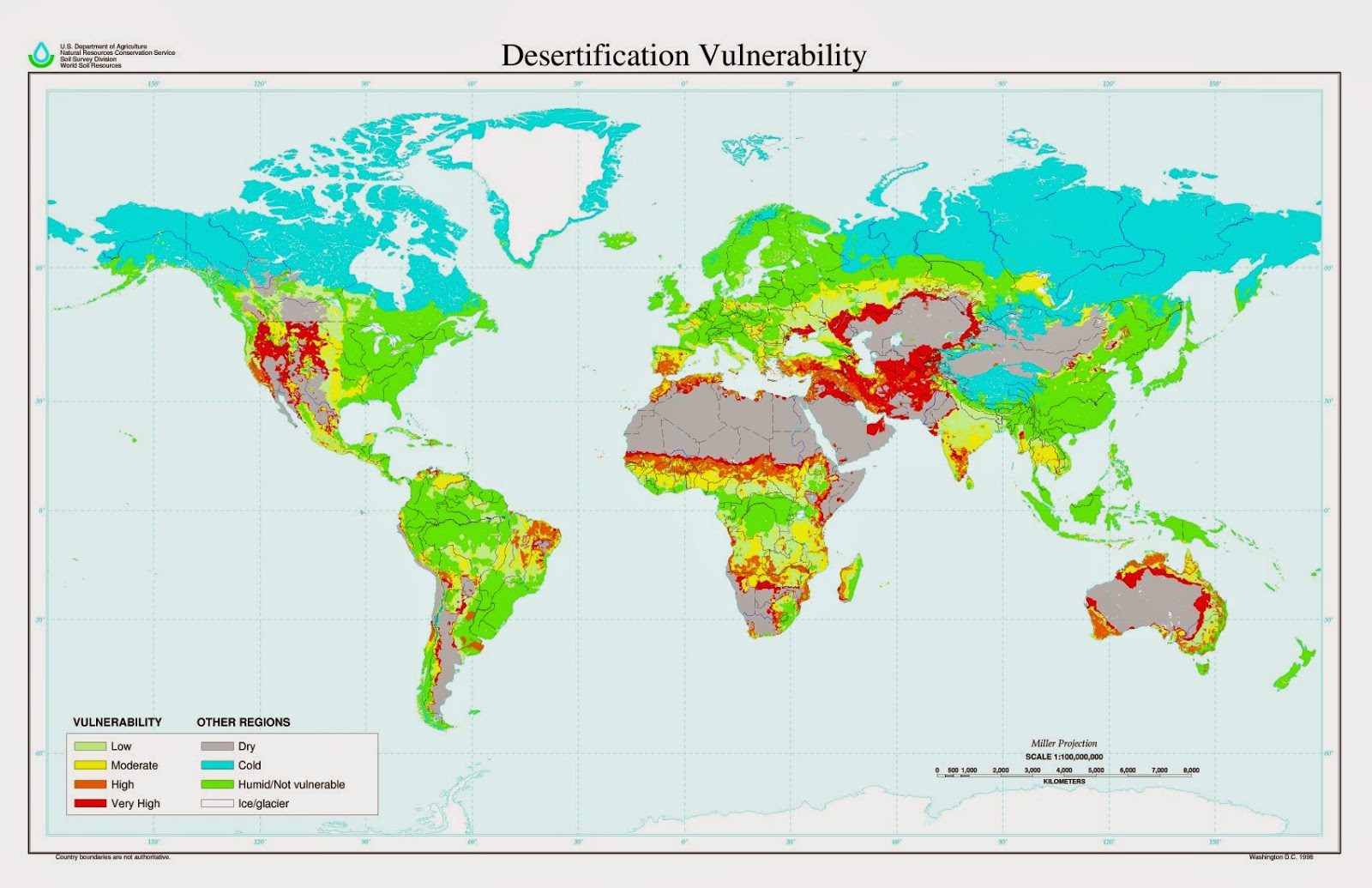
A recent report entitled UN report: one-third of worlds food wasted annually, at great economic, environmental cost sparked in me a concern over land usage and destruction caused by our very own food wastage. Our wasted food accounts for a staggering 28% of the worlds agricultural area or 1.4billion hectares.  All of which ends up in our bin. The article discusses a recent report published by the FAO on our Food Wastage Footprint. With the drastic spreading of desertification, we simply cannot afford to allow 28% of our fertile land produce to be thrown in the garbage. As the diagram below indicates, areas surrounding now desert land (marked in red) are at high risk of desertification, these areas often belong to small countries who are highly dependent on their agricultural use and whose desertification will only cause a ripple effect of increased dependence and indebtedness on agricultural land belonging to more economically wealthy countries.
Copyright: http://upload.wikimedia.org/wikipedia/commons/6/68/Desertification_map.png


The results of a study undertaken by A. Challinor in 2010 suggests that for China, climate change will result in increasing spring wheat crop failure in northeast China due to increasing extremes of both heat and water stress. Now according to this quotation, that study correlates with the image above, where North-east China is at high risk of desertification. There has also been a lot of coverage on rice crop failures in China and the millions of tonnes of GHGs released as a result of this. Although there are ideas being developed to create heat-resistant and drought-resistant crops, the real answer is right in front of us and within reach. Following the FAO report cited earlier, the FAO provided a free toolkit on reducing our food wastage footprint.

Copyright: http://www.rmaf.org.ph/userfiles/
images/profile_pictures/F/fukuoka.jpeg

Another view of desertification which I would like to touch on is that of Masanobu Fukuoka. I recently read a book of his, One Straw Revolution which spoke of his system of natural farming where crops could be grown without plowing his fields, using no prepared fertilisers or agricultural chemicals and did not flood his rice fields as farmers in Asia continue to do. A method which he himself developed and lived by for over 65years and in fact yielded greater quantities of crops than the most productive farms in Japan. This book is highly relevant to the individual and although delves into some technicality, Fukuokas book serves a far greater purpose than farming methods. However it is his second and last book which I find so relevant to this topic of desertification, called Sowing Seeds in the Desert. Although Fukuokas influence has been only marginal so far, the increased rate of desertification begs us to look at alternative possibilities, which include a return to simple but effective methods of farming. Fukuoka reminds us that the present state of our land is not natural but rather a result of our own destructive actions, his silver-longing however, is it can be remedied and perhaps eventually reversed. HIs aspiration was to achieve global food security by natural farming which he practiced and preached in Africa, India, Southeast Asia, Europe and the United States.  Fukuoka offers us an opportunity to put aside our guilt as we face this earths degradation and take a step forward in the right direction.

Una Quinn


Thursday, May 15, 2014

Eating Insects To Save The World, Don’t Let It Bug You!

Source: http://www.ibtimes.com/cupcakes
-made-insects-food-thought-photos-555117
Minestrone with buffalo worms and mealworms (grasshopper garnish optional); termite porridge; ‘land shrimp snack’ made of grasshoppers or locusts with hot pepper oil, lime and salt and protein bars made with cricket flour. These are just a handful of recipes from “The Insect Cookbook: Food For a Sustainable Planet” published by Dutch entomologists Arnold van Huis and Marcel Dicke, along with cooking instructor Henk van Garp[1]. The books main aim is to open our eyes to the fact that our aversion to insects as a food source is senseless and outdated. Unlike livestock and other forms of animal protein, insects are plentiful and nearly everywhere. Whilst, culturally we tend to overlook the possibility of caring for ourselves by insect means, they are a nutrient-rich and sustainable food-source that deserve consideration.

Jon Foley, head of the Institute for the Environment at the University of Minnesota, recently referred to the global food crisis as ‘the other inconvenient truth’ stating that he believes we are at a ‘critical crossroads’. Currently, the population of the world increases by about 75 million people each year. According to the United Nations Panel on Global Sustainability, the world will need at least 50% more food and 30% more water by 2030[2]. As developing countries adapt to modern needs and their economies grow, their demand for meat will increase and to meet this we will need to triple our food production. Unfortunately with current agricultural practices this is an impossible goal.

Source: http://finedininglovers.cdn.crosscast-
system.com/ImageAlbum/3216
/original_694-a.jpg
A recent report issued by the U.N.’s Food and Agriculture Organization (FAO) promoted human consumption of insects as an environmentally sustainable means of feeding the planet. Although it was met with disgust and tossed aside by many, others such as food expert, Ruth Reichl, former editor-in-chief of Gourmet and award winning author recently told the New York Times that “We should all be eating insects, and we all will be eating insects. They are a perfectly reasonable source of protein.”   Like it or not, eating insects (or entomophagy) provides a far more sustainable source of protein than our existing consumption of meat and animal products. Also, most edible insects are very protein rich while being comparatively very lean. For example, a cricket has all the essential amino acids that beef contains but is far higher in iron and calcium. Other insects can provide other micronutrients such as B-vitamins, beta-carotene, and vitamin E.

Not only are insects often more nutritious but they are also a potential solution to the current inefficient food system because of their marginal environmental impact. In general, insects are extremely inexpensive and relatively safe and only require a fraction of the feed, space, water and maintenance of conventional livestock. The current livestock industry is estimated to be responsible for 17-18% of greenhouse emissions and accounts for 70% of all land cleared for agriculture[3]. Almost half of global water is used to produce animal-based foods. Insects, on the other hand, can live off agricultural byproducts such as food waste (e.g. fruit peels) and only a tiny portion of them produce methane, with those that do only producing very small amounts. Also as insects are poikilothermic (i.e. their body temperature remains the same as their surroundings), they are much more efficient at converting nutrition into protein. For instance, crickets need 12 times less food than cattle to produce the same amount of protein and unlike the cruel practice of factory farming, crickets and other bugs actually thrive when they are packed on top of each other[4]. Convinced yet?

With an estimated 1417 species of insects being regularly eaten by over 2 billion people across 3,000 ethnic groups in 80% of countries around the world, it seems it is the Westerners who will suffer most in the long run. But why are we so squeamish when it comes to the idea of chomping down on nice slice of crittle (a cricket and peanut brittle hybrid)?

Most of the Western world readily eats prawns and shrimp, which are arthropods-just, like insects, spiders and millipedes! Therefore, we need to get over this idea that insects are disgusting and stop trying to live in an insect-free world where everything is sterile and clean (after all we wouldn’t be here without the pollinating insects!). But before you get too excited and run down to the local park with a homemade pooter, take heed of the following advice. Like plants, some insects are good for you and some are toxic, aswell as the fact that you can never be sure that wild insects haven’t been exposed to pesticides, therefore, only farmed insects should be consumed. There are also several ‘pestaurants’ opening up around the world with a variety of insects to suit every palate. Experts also caution that we must be careful to develop sustainable cultivation and harvesting methods, as there are examples of human overconsumption that has led to the collapse of some insect species.

Jakub Dzamba, a man who’s researching radical approaches to urban agriculture, is working to build insect farms that can go right into the walls of an apartment building. The idea is that families could feed their food scraps and leftovers to the crickets, and then eat those same crickets, thus solving the dual agricultural problems of production and distribution.  It would therefore seem that these six-legged critters might just find a spot at our table in the not-so-distant future. If we can just start to accept and overcome our fear of munching on food that creeps and crawls, the future looks a little brighter for us humans. Unfortunately, I’m not so sure the same can be said for the future of our possible new food source, who have more of a reason now than ever, to stay away from the ‘light’!

Thursday, May 1, 2014

Trinity College Dublin participates in first Intervarsity BioBlitz

On 1st and 2nd of May four teams of scientists, in four different universities, will race against time to see how many plants and animals can be recorded on their campus in a 24-hour period. TCD is one of four universities taking part in the event, which also includes DCU, NUI Galway and UCC.
But anyone around campus can join in by visiting the BioBlitz Public Lab upstairs in the Science Gallery. The Lab will open at 9.30am on Friday, 2nd of May and provides a great opportunity to meet the scientists involved and find out about the plants and animals that inhabit the TCD campus. Visitors can join in one of three different plant walks at 9.30 which will survey TCD’s gardens, or find out about bugs, birds and moths at the Lab.
One of the key aims of BioBlitz is to raise awareness about biodiversity. As part of the TCD BioBlitz public engagement programme 4th class from St. Mary’s Boys school will visit the Gallery for a workshop on pollinators with Green Bee Education (www.greenbeeeducation.com). The class will make nests for solitary bees which will positioned around campus and will be revisited with a primary school class at next year’s BioBlitz.
Students and staff are being encouraged to get involved by raising awareness of Irish wildlife and the BioBlitz event through social media. Different species flyers created by @daveendangered have been distributed across the campus with specific social media contact details. This is an opportunity for everyone to support the BioBlitz and get involved by creating a SpeciesSelfie through e-mail, twitter and facebook.
For more information about the BioBlitz or how you can get involved please contact Dr Rachel Kavanagh at tcdcbr@tcd.ie.

Visit the Science Gallery on Friday, 2nd May to join in the fun.

The BioBlitz is an initiative of the National Biodiversity Data Centre and An Taisce Green Campus.  This initiative is supported in Trinity College by Trinity Centre for Biodiversity Research, the School of Natural Science, The TCD Green Committee and the MSc students in Biodiversity and Conservation and Environmental Science.

 Dr Rachel Kavanagh

Tuesday, April 22, 2014

Earth Day 2014

Earth Day is an annual event celebrated each year on April 22nd where events are held to support a sustainable world.  Started in 1970 by John McConnel, a peace activist, and Gaylord Nelson, a US Senator, Earth Day celebrates the first day of spring in the Northern hemisphere by inviting individuals and groups from around the world to get involved.  Link


Each year there is a new focus and this year’s theme is Green Cities.  Climate change fuels migration into cities where well over half of our global population now resides…this means that cities will have to adapt and evolve as they grow.


Nick Gray

Monday, April 7, 2014

Ignorance is Bliss, but Knowledge is Power – the importance of education in the move towards sustainable living

I had always considered myself a relatively ‘eco-friendly’ person, enjoying time spent outdoors, despising litter and pollution, growing up in a countryside household that values the environment. I reassured myself that by recycling plastic bottles, walking short distances and by availing of public transport as opposed to driving a car that I was able to justify endless of television and laptop use, recreational shopping and an occasional flight to Europe for a holiday in the sun. In recent years I have since come to accept that I can no longer engage in the same consumption practices of the past without a sharp pang of guilt. The ‘you-should-know-better’ voice inside my head (that developed as a result of four years of environmental and sustainability-related lectures) now lingers when I queue to pay for a heavily packaged pair of shoes, or a box of fruit that has been transported thousands of miles from its source of origin. Education has indeed opened my eyes to the reality of my contribution to increasing carbon emissions and the associated consequences.

As suggested by the title of this blog, to me, ignorance was bliss. Although I was aware that my energy consumption practices far outweigh those of people my age in other parts of the world, it was a thought that rarely crossed my mind. Thus, for several years I was blissfully engaging in the unsustainable mass-consumption economy I was born into. Taking a rather Orthodox Marxist perspective, I would argue that the environmental issues at hand today are inherently interlinked with this capitalist system and that the current crisis of the situation necessitates a demand for scientific, technological and other developments to improve our current understanding and the methods employed for resolving these issues. This information then needs to be distributed to and understood by people of all ages, across all levels of society, in both the public and private sector. In short, we need education.

As my awareness of the extent of the global environment issues grew, I must admit the temptation to adopt a despondent, existential attitude was there – after all, given the magnitude of the situation, if nobody else was making changes what difference could I make? However I ultimately believe that knowledge, particularly knowledge pertaining to the effects of an individual’s lifestyle and personal choices, has the ability to empower and inspire meaningful action. The role of education in this regard has become increasingly recognised by actors and organisations across multiple spheres. Departments of Education worldwide and multinational organisations such as UNESCO and the WWF run programmes in support of sustainability-based education. Such courses aim to promote sustainable lifestyle choices and often take a particular focus on the education of younger generations. In August 2013 for example, the Irish Department of Education and Skills launched a plan to develop the ‘National Strategy onEducation for Sustainable Development in Ireland’. This strategy expresses the significance of education. It aims to establish sustainable development learning at all levels of the education system and to promote public awareness and create support for education for sustainable development. I strongly believe the implementation of such strategies, as part of a wider movement that recognises the importance of education, is the first step in the long road to sustainable living.

Claire Quinn

Further information:
Nevin, E., 2008. Education and sustainable development. Available at: http://www.developmenteducationreview.com/issue6-focus4
Journal of Education for Sustainable Development, 2013.  Available at: http://jsd.sagepub.com/

Friday, March 28, 2014

Eco Living, Ahoy Mate!


The idea of living in an 8 by 20 foot steel box is enough to get you a few raised eyebrows and ‘are you mad?’ comments. But what if that box was spacious, homely, fully transportable, cheap, fire and flood proof, fully functional and designed to your own taste whilst keeping your ecological footprint to a minimum? If that sounds a bit better than maybe you are in the market for the latest green home, a converted shipping container.
http://ecovidainternational.com/eco-design-and-construction/
can-you-build-with-shipping-containers-in-spain/

Taking reuse to a new level there has been an upsurge in the use of old, disused containers in to modern, quickly assembled and environmentally friendly homes throughout the globe. It has been estimated that there are up to 24 million containers that will never be used to transport cargo again and not only do these make great temporary homes for those in crisis (they were used as emergency accommodation for people after the 1988 earthquake in Armenia) they also make excellent contemporary office and living space (there’s even one down the road from me being used as stables!). One important aspect is that they are cheap to acquire in the first place. A quick scan of buyandsell.ie shows some for sale for as little as €1,600 + VAT.
The fact that these homes are making use of a discarded material already makes them smart ecologically but many of them have incorporated features to make them that bit more sustainable. Some containers sport solar panels angled on the roof and others have small wind turbines and energy efficient windows. Another eco-friendly aspect it that it takes very little time for the setup of these homes which facilitates less disturbance to nature and also that they are transportable meaning they are not permanent in that area. Timber is also not required in the way that it usually is for many other house builds. One company has designed an ‘ecopod’ container to show just how sustainable you can make them. The ‘ecopod’ has recycled flooring, a solar powered fridge, a compostable toilet, wall sockets and 12v lighting that is powered by the roof mounted solar panel.

http://www.designtopnews.com/architecture-design/greentainer-eco-fied-
container-architecture/

If you think you need to compromise on the design aspect of the house in order to gain all these benefits think again. The containers can be piled high on top of one another, or fused together creating a manipulated masterpiece. They can be changed past the point of recognition or left in their original state bringing an urban renewal feel to the place there are also ones designed to disappear in to the natural background. The architectural possibilities are endless once you remember to think outside the box (a steel one in this case!).

Have a look at the links below if you want to see some globally inspiring uses of containers from skate parks to student housing: http://www.popularmechanics.com/home/shipping-container-homes-460309#slide-1