This blog was originally based on a course ran by Professor Nick Gray of the Trinity Centre for the Environment at Trinity College Dublin who also wrote a textbook for the module Facing up to global warming: What is going on and what you can do about it. Now working as an independent consultant, Nick continues to work in the area of environmental sustainability and looking at ways of making a difference without recriminations or guilt. Saving the planet is all about living sustainably.


Showing posts with label sustainable living. Show all posts

Thursday, August 29, 2019

Happy 500th Birthday


Today my reusable nylon bag which I was given for Christmas two years ago has reached it's 500th birthday...that means I have not used new 500 bags which means a lot of saved CO2e  

To explain about why using reusable bags is so important I have reproduced a section of the book Facing up to Global Warming.  The thing that really annoys me is when I am offered a paper bag they always double or triple up the bags in case it rips.  Do we really need fancy thick paper bags with ribbons and metal rivets when we buy clothing or luxury goods?  Of course not.  So hopefully this will answer some important questions about bag use and why we should all used reusable bags.


Plastic v paper bags
Globally between 500 -1000 billion standard supermarket high density polyethylene (HDPE) bags are  used each year with 6 billion handed out free to shoppers just in UK during 2012.  The problem of these bags is really the major litter problem that they pose as well as being a major threat to wildlife.  In terms of their carbon footprint this is significant due to the large numbers used.  The transparent ultra thin lightweight HDPE bags (just 0.025 mm thickness) that you use to put loose vegetables in have a footprint of 3g CO2e each.  The standard printed lightweight supermarket HDPE bag is equivalent to 10g CO2e each. The thicker reusable supermarket HDPE bag can vary between 100-280 g CO2e in their manufactured footprint. So for those worried about their footprint, what are the alternatives to the standard supermarket HDPE bag? 

Well interestingly the standard printed lightweight supermarket HDPE bag contains 35% less CO2e than the equivalent sized paper bag.  When paper bags are used for groceries then you are often given two bags one inside the other to give the bag sufficient strength, so an equivalent paper bag may have six times more embedded CO2e than the plastic version to give it the same strength. A standard reusable HDPE bag contains 10-28 times more CO2e than the standard printed lightweight supermarket HDPE bag, while cotton or canvas bags contain on average 171 times more CO2e.  This means that you would need to reuse your plastic or canvas bag in excess of 20 or 170 times respectively in order to gain an emissions advantage over using the thinner bags just once. A study by the Environment Agency in the UK found that canvas bags are used on average only 51 times with composting the best disposal, making them potentially far less climate friendly than the plastic bags in terms of overall carbon emissions. To put the standard supermarket HDPE bag into perspective, then it contains only one thousandth of the CO2e than food inside the bag.

What to do with plastic bags?  Interesting there are three options. Burning or incineration releases toxins and 100% of the embedded CO2e is released, although some heat is generated.  If we recycle the bags then up to 50% of the embedded CO2e is lost in the process.  In contrast, burying the bag in a landfill ensures the embedded CO2e is stored permanently with virtually no CO2e released to the atmosphere.  Difficult decisions eh?

In Ireland the standard supermarket HDPE bags have a levy of 15 cent each on them so that they are virtually never used by customers.  Before the levy was introduced the countryside was littered with the bags, and now such bags are virtually never seen as litter items, except unfortunately containing dog poo, but that is another story.  Transparent ultra thin bags are still given out free in supermarkets.  In contrast, China banned both the standard and ultra thin HDPE bags and called people to use baskets or cloth sacks instead to reduce environmental pollution, including marine litter.  This ban, introduced in 2008 saves 35 million barrels of oil a year in their manufacture.  Ironically China has been the largest manufacture and exporters of such bags to the rest of the world.

So perhaps in terms of emissions the best option if you need a plastic shopping bag is to use a reusable HDPE bag and make sure you use it at least 20 times for a thick plastic bag or 35 times for a woven plastic bag otherwise you will have emitted more CO2e than if you had used disposable bags.  I called the standard lightweight supermarket HDPE bag disposable because we tend to consider them as a single use item.  In fact they can be used again and again if you are careful, which is putting the investment in reusable bags under pressure.  Lightweight supermarket HDPE bags have loads of different uses so it is important that they are reused as many times as possible, finally using the bag to wrap contaminated unrecyclable waste for disposal to landfill. 

We all have cupboards full of reusable bags…the trick is to actually use them carefully to ensure that they have long lives.

The challenge is how many times can you use them beyond their breakeven point?


Paper is  hard to reuse so
ALWAYS RECYCLE
to save CO2e emissions
What about paper bags?  Using them certainly feels that you are caring for the environment being a natural product. The paper industry is very energy intensive so that the carbon footprint for all paper is quite high ranging from 12g CO2e for a lightweight recycled bag to in excess of 80g CO2e  for a virgin paper (e.g. clothing) bag excluding the non-paper handles.  Virgin paper releases between 2.5-3.0 kg CO2e per kg of paper manufactured compared to 1.25-1.50 kg CO2e per kg of recycled paper.  Of course the embedded CO2e in the paper is released when paper is either burnt, landfilled or composted which is equivalent to 500g CO2e per kg paper on top of the emissions from its manufacture.  So only use paper bags when necessary and ensure that they are full.


Plastic bags, paper bags, and recyclable bags…what do we do? The golden rule is to avoid plastic and paper bags whenever possible.  If you buy reusable bags put a date on them and ensure that you use them well over the breakeven point in terms of emissions. I know it looks awful but rips and holes can be repaired with sticky tap. I would recommend that you invest in long life alternatives (e.g. rucksack, stacking trays for the car).  I brought a high quality canvas bag from Oxfam ten years ago which I have used everyday not only for shopping but for work.  Of course neither my wife nor my daughters will be seen out with me when I am carrying it, but it has proven exceptionally climate friendly.  So you need to find a compromise. 

Having a strategy in place for carrying goods without disposable bags is a surprisingly effective way of minimizing CO2e emissions over a lifetime


Monday, April 7, 2014

Ignorance is Bliss, but Knowledge is Power – the importance of education in the move towards sustainable living

I had always considered myself a relatively ‘eco-friendly’ person, enjoying time spent outdoors, despising litter and pollution, growing up in a countryside household that values the environment. I reassured myself that by recycling plastic bottles, walking short distances and by availing of public transport as opposed to driving a car that I was able to justify endless of television and laptop use, recreational shopping and an occasional flight to Europe for a holiday in the sun. In recent years I have since come to accept that I can no longer engage in the same consumption practices of the past without a sharp pang of guilt. The ‘you-should-know-better’ voice inside my head (that developed as a result of four years of environmental and sustainability-related lectures) now lingers when I queue to pay for a heavily packaged pair of shoes, or a box of fruit that has been transported thousands of miles from its source of origin. Education has indeed opened my eyes to the reality of my contribution to increasing carbon emissions and the associated consequences.

As suggested by the title of this blog, to me, ignorance was bliss. Although I was aware that my energy consumption practices far outweigh those of people my age in other parts of the world, it was a thought that rarely crossed my mind. Thus, for several years I was blissfully engaging in the unsustainable mass-consumption economy I was born into. Taking a rather Orthodox Marxist perspective, I would argue that the environmental issues at hand today are inherently interlinked with this capitalist system and that the current crisis of the situation necessitates a demand for scientific, technological and other developments to improve our current understanding and the methods employed for resolving these issues. This information then needs to be distributed to and understood by people of all ages, across all levels of society, in both the public and private sector. In short, we need education.

As my awareness of the extent of the global environment issues grew, I must admit the temptation to adopt a despondent, existential attitude was there – after all, given the magnitude of the situation, if nobody else was making changes what difference could I make? However I ultimately believe that knowledge, particularly knowledge pertaining to the effects of an individual’s lifestyle and personal choices, has the ability to empower and inspire meaningful action. The role of education in this regard has become increasingly recognised by actors and organisations across multiple spheres. Departments of Education worldwide and multinational organisations such as UNESCO and the WWF run programmes in support of sustainability-based education. Such courses aim to promote sustainable lifestyle choices and often take a particular focus on the education of younger generations. In August 2013 for example, the Irish Department of Education and Skills launched a plan to develop the ‘National Strategy onEducation for Sustainable Development in Ireland’. This strategy expresses the significance of education. It aims to establish sustainable development learning at all levels of the education system and to promote public awareness and create support for education for sustainable development. I strongly believe the implementation of such strategies, as part of a wider movement that recognises the importance of education, is the first step in the long road to sustainable living.

Claire Quinn

Further information:
Nevin, E., 2008. Education and sustainable development. Available at: http://www.developmenteducationreview.com/issue6-focus4
Journal of Education for Sustainable Development, 2013.  Available at: http://jsd.sagepub.com/

Friday, March 28, 2014

Eco Living, Ahoy Mate!


The idea of living in an 8 by 20 foot steel box is enough to get you a few raised eyebrows and ‘are you mad?’ comments. But what if that box was spacious, homely, fully transportable, cheap, fire and flood proof, fully functional and designed to your own taste whilst keeping your ecological footprint to a minimum? If that sounds a bit better than maybe you are in the market for the latest green home, a converted shipping container.
http://ecovidainternational.com/eco-design-and-construction/
can-you-build-with-shipping-containers-in-spain/

Taking reuse to a new level there has been an upsurge in the use of old, disused containers in to modern, quickly assembled and environmentally friendly homes throughout the globe. It has been estimated that there are up to 24 million containers that will never be used to transport cargo again and not only do these make great temporary homes for those in crisis (they were used as emergency accommodation for people after the 1988 earthquake in Armenia) they also make excellent contemporary office and living space (there’s even one down the road from me being used as stables!). One important aspect is that they are cheap to acquire in the first place. A quick scan of buyandsell.ie shows some for sale for as little as €1,600 + VAT.
The fact that these homes are making use of a discarded material already makes them smart ecologically but many of them have incorporated features to make them that bit more sustainable. Some containers sport solar panels angled on the roof and others have small wind turbines and energy efficient windows. Another eco-friendly aspect it that it takes very little time for the setup of these homes which facilitates less disturbance to nature and also that they are transportable meaning they are not permanent in that area. Timber is also not required in the way that it usually is for many other house builds. One company has designed an ‘ecopod’ container to show just how sustainable you can make them. The ‘ecopod’ has recycled flooring, a solar powered fridge, a compostable toilet, wall sockets and 12v lighting that is powered by the roof mounted solar panel.

http://www.designtopnews.com/architecture-design/greentainer-eco-fied-
container-architecture/

If you think you need to compromise on the design aspect of the house in order to gain all these benefits think again. The containers can be piled high on top of one another, or fused together creating a manipulated masterpiece. They can be changed past the point of recognition or left in their original state bringing an urban renewal feel to the place there are also ones designed to disappear in to the natural background. The architectural possibilities are endless once you remember to think outside the box (a steel one in this case!).

Have a look at the links below if you want to see some globally inspiring uses of containers from skate parks to student housing: http://www.popularmechanics.com/home/shipping-container-homes-460309#slide-1


Saturday, March 15, 2014

The Potential of Geothermal Power


The development of more sustainable, cleaner and cheaper sources of energy is being driven by the depletion of fossil fuels and their impact on our environment through release of greenhouse gases. Geothermal energy is one of these upcoming new sources that today is relatively untapped but its potential can be seen in countries such as  Iceland where 25% of its electricity and 90% of its heating is obtained from geothermal power.[1] This energy is derived from the thermal energy beneath the earth's surface that resulted from the original formation of the earth as well as the radioactive decay of elements uranium, thorium and potassium. On average one kilometre of depth corresponds to a rise in temperature of about 20oC. The temperature inside the earth melts rock and also heats up water trapped in cracked and porous rock to create geothermal reservoirs of hot water and steam. Geothermal power plants rely on these reservoirs to harness the heat energy to produce electricity by drilling deep wells into the earth and piping steam or hot water to the surface and using it to drive generator turbines.[2] This water is then piped back into the reservoir through injection wells to be reheated and thus with careful management to maintain the viability of these reservoirs  makes this process of obtaining energy, sustainable. Geothermal power plants emit approximately 1% of the sulphur dioxide, <1% of the nitrous oxide and 5% of the carbon dioxide that is emitted by a similar sized coal-fired power plant.[3] Geothermal energy has an advantage over other renewable energy resources such as solar or wind energy in that it can provide us with  a consistent and more reliable supply of power. There was 8,933 MW of installed capacity in 24 countries with geothermal power plants in 2005 and this has risen by almost 20% to 10,715 MW which generates 67,246 GWh/year  in 2010 according to a report by the International Geothermal Association.[1]               

The United states leads the world in the production of geothermal electricity with an installed capacity of 3,086 MW which is equivalent to the electricity obtained from burning 60 million barrels of oil.[1,4] This 3,086 MW relates to only less than 0.5% of the United states total electricity usage and shows how much of an untapped resource it is today. However there are a few problems that need to be overcome to promote the development of geothermal power plants. One of these problems is the high costs of drilling wells which can be between $2.3-4.0 million for a depth of 1500-3000 meters.[5 ]Another problem is the limited areas in which the conditions are suitable, which was normally  an area near the boundaries of tectonic plates. Although this problem is currently being resolved with the development of Enhanced Geothermal Systems technology that allows us to create our own geothermal water reservoirs. With most governments know realizing the effects of green house gases on our environment, geothermal energy will definitely be considered as a potential sustainable energy resource and may even be considered better option in countries such as Ireland where the development of a nuclear power plant will most likely be met with a large opposition.

Michael Rooney


Thursday, February 6, 2014

Seminar: Is biodiversity a driver in the health benefits of green space?

A  Special Seminar will be held on Friday 14th February 2014, 2-3 pm in the Botany Lecture Theatre  by Dr Jenny Roe, Senior Research Leader for Health and Wellbeing, at the Stockholm Environment Institute, University of York.  The talk

 'Is biodiversity a driver in the health benefits of green space?'

examines the effect of green space on wellbeing which is a hot topic just at present. Find out more about Jenny’s research  at  http://www.york.ac.uk/sei/staff/jenny-roe/

http://www.eco-business.com/news/green-spaces-boosts-
wellbeing-urban-dwellers-study/

Tuesday, July 2, 2013

Dinner’s on me

The food we eat everyday forms a critical component of our carbon emissions. How we get this food and what we do with the waste form the integral part of this problem.While as consumers we have limited control over the agricultural practices, food wastage is entirely down to us. What makes this problem even more dramatic is the fact that food wastage is a completely unnecessary and avoidable in today’s modern world. Coming from an agricultural background and working part time in a local supermarket, I have experienced first-handthe huge wastage that exists among society today.
According to the Department of Agriculture’s websites, 29% of Irelands total national carbon emissions in 2009 came from the agricultural sector while food wastage accounted for approximately 15 million tons of CO2emissions each year in the UK.  This area urgently needs to be addressed. Working part time in my local supermarket has given a prime insight into the food wastage that occurs there on a daily basis. Date checks have to be carried out on all products on a daily basis. When most products near their expiry date they are marked down in price, however meat and dairy products have to be removed a day before their ‘best-before’ or ‘use-by’ date, resulting in huge wastage. These products are simply thrown in the bin. Similarly, living on a farm has given me an insight into the wastage that occurs before products even reach the shops. Many perfectly healthy vegetables are deemed to be ‘unsellable’ due to their unusual shape or appearance. While food is wasted every day in first world countries such as Ireland, 239 million people in Africa go hungry every year.
Now that we are aware of the problem, what can be done in order to obtain our food in a more sustainable manner? Examples of sustainable initiatives at a nationwide level include:
·         In America, food collecting organizations have been established and collect food from restaurants, supermarkets and cafeterias that would otherwise be thrown out and distribute it to low income families and the homeless. If a similar plan was adopted in Ireland it would significantly reduce food wastage in supermarkets across Ireland.
·         Since the fall of the Celtic tiger in Ireland, there has been a growing trend towards allotment gardening where people can grow their own fruit and vegetables. I was interested to learn during the Living Sustainably course that anything grown in an allotment or garden in season is equal to 0g CO2e kg-1.If county councils across Ireland committed to supplying land for allotment gardening, carbon emissions would be significantly reduced.
·         In response to the emissions from agriculture, the Department of Agriculture has committed to a plan of planting new forests and maintaining good forest management in order to counteract CO2 emissions.
However real change is needed at the basic human level and it is up to each and every one of us to change our consumer habits to ensure a sustainable planet for the future.  By committing to buying only the food we really need, to buy food that is locally produced and in season and by avoiding unnecessary food packaging we can make a big difference to the planet.
 Additional Information can be found on:
·         http://www.allotments.ie/
·         http://www.agriculture.gov.ie/

Paul

Wednesday, June 26, 2013

Carpooling: The Drive to Green.

It was the summer of 2010; myself and a friend were on a trip of a lifetime inter-railing around Europe. For those of you who have never inter-railed, an inter-rail pass is a train ticket for EU members allowing you to travel between countries in the EU over a period of time.
Inter-railing is an experience to say the least. Leaving aside the crazy nights out, the sun, sea, historical sites and the people you meet along the way. You can often arrive in new location tired, hungry, and bagged down and with no idea of where you’re staying, or what you’re doing.
It was this mixed bag of emotions which we were carrying when we were hurled off an overnight train in Stuttgart mid journey from Munich to Paris. The train had been double booked, they had no record of our reservations, and no sympathy for the tired tears that ran down our grubby faces – Off we stepped at 3am into Stuttgart. We desperately needed to get to Paris on time –but how? Despite the lack of customers one solitary café remained open despite the lack of customers. This Café introduced us to a Danish girl who was fluent in English and German, she kindly helped us to look up tickets for the next train, and at two hundred Euros each we quickly resigned to the fact that we were doomed.   Seeing our reaction the Dane stepped up her game and introduced us to the Mid- European phenomenon of Carpooling.
The majority of us have heard of people sharing lifts to work or school in order to save; time, money and of course the environment. This goes a step further. We found a website advertising free spaces in a car which was travelling from one destination to another, each passenger pooled their money together to pay for the petrol. So there we were at 4.30 am calling a strange number arranging a lift to Paris from Stuttgart and by 7 am we were in a car with four other people! By pooling together we saved the money and the environment through more efficient use of petrol as it would take the same amount of petrol to take one of us from Stuttgart to Paris.

Carpooling evidently means more people in a one car, this means less cars on the road, this can directly lead to less pollution; Less air pollution, noise pollution, less carbon emission, less greenhouse gas emission. Evidently carpooling is a major and direct step towards a cleaner and greener environment.  When we arrived safely in Paris we wished our fellow commuters a nice trip and parted ways. For a simple 30 euro each we made an economical saving of 170 euro each, in comparison to the alternative train ticket, while simultaneously saving the environment.

Although many people have questioned the safety element of ‘getting in a car with a stranger’ this carpooling idea could easily be adopted to the business sector of Ireland with many people making trips from Dublin to Galway or Cork on a daily basis it would be a safe and easy way to save the money and the environment to simply set up a business carpooling community and drive towards green.
Jane Farrelly

Friday, June 14, 2013

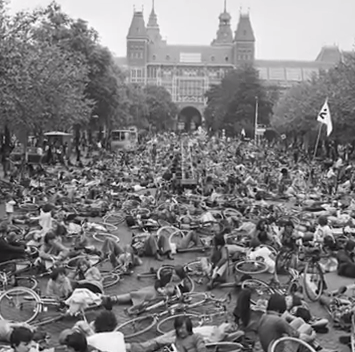
Learning from the Dutch cyclists – another important lesson

Learning from the Dutch cyclists – another important lesson
Mass cycling protest in Amsterdam
http://www.brainpickings.org/wp-content/uploads/2012/01/dutchbikes.png
The Netherlands is famous for its cycling infrastructure and policy. In light of climate change and the push to engage in more sustainable lifestyles, cities across the globe have been turning to the Dutch cycling model and trying to integrate its elements into their own sustainability/transport plans and policies. The Dutch cycling culture of today; however, is certainly different than it was in the past.
In the years after WWII, automobile usage skyrocketed following the rapid rebuilding of a war-torn country. Congestion of city streets and marginalization of cyclists quickly became apparent, but one of the most terrible effects of this shift towards automobile use was the number of accident-related deaths of children (400 in 1971) that occurred (1). Mass protests, notable the “Stop Child Murder” campaign became popular, and public pressure to create safer, more cycle and pedestrian friendly streets ensued. Finally, changes in policy and planning were generated at the government level with amazing results. Child deaths were significantly reduced, many city centers became car-free, and infrastructure changed dramatically to reflect the high priority of cyclists visible in Dutch cities today.
While I could write a whole other blog post on the successes (and failures) of learning from and implementing similar cycling models in other cities, I have chosen to highlight another lesson we should be reminded of from the Dutch experience.
The shift from the popularity of the automobile towards a more sustainable means of public transportation was achieved through protesting and public pressure on the government. What alarms me is that the main driver of these protests was the loss of life. It appears as though the 3,300 accident-related deaths in one year (1) was what it took for the public to finally rally together and effect change.
When I think about the heaps of changes that need to be made in our current lifestyles to live more sustainably, I wonder what it is going to take before we get that critical mass of people that can influence our government to help us make these changes on a large scale. There is an overwhelming amount of advocacy groups, initiatives and campaigns geared towards aspects of sustainable living – could any one of these be the next “Stop Child Murder” campaign and cause a great shift towards another element of sustainable living? It is my hope that we can be proactive, that we can stand behind movements to help them reach that critical mass, but that this can be done before we begin to see such severe, direct consequences such as loss of life. Let us learn not only from the fantastic example that the Dutch sets on sustainable transportation, but also from the way this change was effected.
Heather Stark

Saturday, June 1, 2013

My Carbon Cycle

The daily commute is something most people dread. Living in Glenageary and spending 5 days a week in college in the city centre, I spend approximately 90 minutes a day on buses (if I’m lucky and dodge the traffic!) which amounts to a whopper 450 minutes a week sitting on an over-crowded bus listening to other peoples music bleeding from their headphones. It’s time I loath to waste, but it’s not just time that I’m wasting.
My bus journeys make me accountable for about 20km of CO2 production weekly! Inspired by the clearing of the rainclouds and the signals that we may actually begin to experience something resembling Spring, I set myself what seemed like an achievable task: to forgo the buses for a week and instead cycle to college for the week. It seemed like a win/win situation: I’d be using a carbon neutral form of transport and I’d be saving on bus fare. “Why doesn’t everyone do this?” I asked myself as I set off on a crisp March Monday morning.
“Why doesn’t everyone do this?”

About an hour later, as I arrived panting into college, feeling like my legs were about to burst into flames, I found the answer to my own question: This is hard! Every tweak we make to our lives to make them more sustainable requires us making sacrifices.
I believe, in the developed world we are so accustomed to a plethora of amenities and indulgences which work their way into becoming part of our day-to-day lives. Removing even the smallest of these from your routine, is a huge shock to the system. It’s a change that can take a huge amount of adjustment to our daily routine and an element of sacrifice. Therefore, people living comfortable, perhaps financially sustainable lifestyles just simply can’t be bothered. Why go without when making a sacrifice which results in decreasing your carbon footprint puts extra strain or discomfort in your life when the benefits cannot be immediately seen?
It is an uphill battle that environmentalists face: convincing those so consumed with the present that they are directly contributing to the destruction of our future. The allure of immediate gratification is hard to compete with, however we must persevere and accept that seemingly small individual sacrifices now amount to huge collective benefit in the future.
This is a lesson I’ve heard many times, but only really rang true with me when I decided to make a personal sacrifice for the good of the environment in which I live. Taking the bus was by far the easier, passive option. But I had to ask myself, can I afford to knowingly be that selfish and not feel guilty? The answer was no. I’ve persevered with the cycling with some exceptions here and there (there’s no accounting for torrential downpour!) and have willingly made an achievable sacrifice for the greater good. Not to mention the bus fare I’m saving!
Stephen Lehane

Friday, April 26, 2013

Recycling and My Sandwiches

Recycling is one of those things that, in my experience anyway has been drilled into me from a young age. It is something that as I grew older I became complacent with. I went to a primary school which had a green flag and a secondary school which had a strong recycling policy. I won’t sound very academic when I say this but I never really questioned any of it I just recycled because I was told to and admittedly was a bit scared of the consequences if I didn’t. Putting your yoghurt pot in recycling the bin seemed like an easy alternative to a detention.

Now that I am in college and have left all the fear behind I have continued to recycle out of habit but it was only really when I started the living sustainably course that I began to assess what  impact  recycling  can have.  Just looking around college, we as students are producing a lot of waste. I know for me any way I would throw my drinks bottle and paper wrapper from my roll straight into the nearest bin, whether it be recycling or not. Generally speaking it is not!

One of the tasks on this course was to examine the contents of a refuse sack at home.  I live in my family home so as a whole we would produce more waste than the average group of students living in rented accommodation.  This was a seemingly basic task, I remember doing the same in primary school and proceeding to harp on at my mum for her lack of awareness about all things green.  This time I was approaching it in a new light with the understanding that we as a community of inhabitants of the earth really do not look after what we’ve got.

On examining the bin I found a number of things and I have mentioned this in my assessment. Firstly, the general waste bin I found cling film and then aluminum foil. These are both very commonly used household products. Even for those who but lunch when they are in college many sandwiches are wrapped in such packaging.

This may sound silly but I wasn’t sure whether or not these could be recycled. I took it upon myself to check. (This course really has made me interested in the world around me!). It transpires that cling film cannot be recycled everywhere and neither can aluminium foil.  I was shocked at this! Cling film is something that I would have always choses over aluminum foil simply because I believed it would be recyclable and more ecofriendly than aluminium. I’ll admit, this seems like a very small and insignificant discovery but if it were not for this module I wouldn’t have checked.  So my answer is to get a lunch box.

Although a tiny thing I am now more aware of the small changes I can do to avoid contributing to landfill. Something as small as what I chose to wrap my sandwiches in everyday.

I realize I have picked up on a very small issue however out of the whole module I feel it is one thing in particular that felt very relevant to my life and I felt it was something I could deal with straight away.

Naomi Gibson

Thursday, April 18, 2013

The Real Cost of a Google Search!


Can Google go Green? 

Google searching has become a basic tool in everyday life. If you don’t know the answer, just Google it! Since its launch in 1997, billions of people worldwide have been using it. It’s a free search engine which I’m pretty sure most people use on a daily basis. For us it’s free to use, but what is the real cost of a Google Search? There are many factors that need to be taken into account, such as the amount of carbon dioxide emitted not only from generating the search results, but the emissions from our electronic devices while we are searching.
A typical Google search takes on average about 0.2 seconds to return results. That Google search is equivalent to about 0.2 grams of CO2. [1] It seems to be a small enough figure. But in 2011, Google handled about 1,722,071,000,000 searches! [2] That amounts to roughly 350 thousand tonnes of CO2 emissions that year! But who owns that carbon emission? Us or Google? We’re the ones using the search engine, but Google’s the one that’s returning the results. Google has gone green and offset their carbon emissions to deal with their environmental impact. We too should aim to reduce our carbon emissions.
That was just the carbon dioxide emission cost of the actual Google search, the cost of running the device that the search is done on has not been taken into account yet! According to a Harvard University physicist, a typical search on a desktop computer generates about 7 grams of CO2. [3] This is taking into account the CO2 emissions generated from both the Google search and the desktop computer. So really that amounts to about 12 million tonnes of CO2 emissions for the year 2011 just for Google searches!
In doing this blog alone, I have already done three Google searches. One for finding out the actual cost of a Google search, another for how many searches Google handled in one year and finally another for getting an image for this blog. So I have already generated 21 grams of CO2 just by searching for information for this blog. This does not include the time I spent using the computer to type this blog up and emailing it!
So how can we reduce our Google search carbon emissions? Instead of making unnecessary searches, we should think about what we really need to look up. In fact, we can reduce our overall carbon emissions by using sustainable renewable sources of energy, such as wind and sunlight. If our electronics are powered by renewable energy, we have already immensely reduced our CO emissions.
Ivana Yeow

Sunday, April 14, 2013

Is Healthcare Exempt From Environmental Care?

Those who preach that ‘the power of one’ will save our planet and allow us to coexist in a sustainable manner are right: If every individual made a significant effort to turn off lights, to conserve fuel and to reduce waste, each minute action would have a cumulative effect and we could prosper sustainably. However, I feel there is an over-emphasis being placed on small actions and that large siphons of the country’s resources, such as the health sector, are, to a certain extent, being disregarded, sidelined or taken for granted.
           
Last summer, I was diagnosed with a systemic autoimmune disease and, during my stay in the hospital; I underwent two X-rays, one MRI, one CT scan, an ECG and numerous blood tests. Finally, the conclusion was reached that I had sarcoidosis. My mother also has sarcoid. Before any test took place, identification of identical symptoms could have indicated I have the same, genetically linked, disease. In hindsight, I cannot help wonder if all the tests were truly necessary? Helium, supplies of which are critically low, is essential for MRI machines. Did I really need the MRI scan to confirm something we already suspected? It’s a frightening reality that, in the near future, an MRI may not be an option for those that genuinely need such an invaluable diagnostic tool. X-ray, MRI and CT scans also require a substantial amount of energy to power. These key diagnostic tools are clearly invaluable to hospitals, however, strides could be taken to supply alternative, more energy efficient options.
           
During my stay on the ward, I realized lights remained on throughout the night and the heating was constantly on. I realize it’s important to maintain a comfortable ambient temperature, however it was July and much of the time the windows were opened, as the heating was stifling. Up to 70% of the expenses of a hospital comprise heating and lighting. Perhaps, by making smart decisions and incorporating a more environmentally friendly ethos, hospitals could cut down on both their expenses and carbon footprint.
           
Furthermore, when I received my prescription, I could not understand why so much packaging was ‘necessary’. Of course it is imperative to ensure medication is sterile, desiccated and airtight. However, I received several large, colourful, cardboard boxes, half-filled with blister packs: plastic packaging with foil laminates that are practically impossible to recycle. Was it necessary to house the sterile packs in a large, aesthetically pleasing box? Would it not be less wasteful to minimize packaging?
           
I also feel the quantity of medication produced needs to be more accurately monitored to avoid excessive and unnecessary waste. In Wales alone, over 250 tonnes of out of date or surplus medication amounts each year. It seems heedless to manufacture such an excess of medication, which must undergo costly and elaborate methods of disposal. That’s not including the large proportion of medication that is improperly disposed of, which impacts the environment by entering and contaminating water. Recent reports from India indicate that levels of antibiotic in the surface water surrounding a certain drug factory were actually higher than the levels of drug found in patients undergoing treatment!
           
I truly believe we cannot let any sector be exempt from responsibility for the environment, even one as invaluable to society as healthcare. If we are to have any hope of achieving our environmental goals, the greatest contributors to energy expenditure must be addressed and made aware of the importance of adopting a new attitude. In 2009, the carbon footprint of the US healthcare sector was estimated to be 546 million metric tonnes CO2e per year. We need to work together, with the health industry, to mitigate our global environmental crisis.

Áine O’Toole 

Some interesting Research Sources: