
Showing posts with label Trinity College Dublin. Show all posts
Showing posts with label Trinity College Dublin. Show all posts
Saturday, December 12, 2015

Tuesday, November 17, 2015
90% of seabirds have consumed plastic
 |
| . Photograph: Chris Jordan/Midway: http://bit.ly/1iYURFI |
Our litter and waste has reached a new level of disbelief with a
new study showing that upto 90% of seabirds will have ingested plastic items
they have mistaken for food. A report in the Guardian has highlighted
their work link. Their results can be seen in the Proceedings
of the National Academy of Sciences.
We still haven’t learnt as our production of platics in the past
11 years exceeds the amount produced since it was first produced in the 1950s.But something is
being done and new a new collection boom is
hoping to start removing larger material soon.
You can help right now by picking up litter that will find its way eventually into the sea.
Posted: Nick Gray
Twitter @Nickgraytcd
Friday, November 13, 2015
Major Greenland glacier victim to global warming
 |
Image time series of Greenland’s Zachariæ Isstrøm glacier as seen by the
NASA/USGS Landsat satellite. Retreat of the glacier front is indicated by lines,
color-coded from dark green (2003) to light green (2015).Credits: NASA/USGS
|
Adjacent to this is another large
glacier Nioghalvfjerdsfjorden which is melting at a slower rate, but together
they make up 12% of the Greenland ice sheet, so together they will raise sea
levels by more than 39 inches (99 centimeters) if they completely melt.
NASA has a new project -
Oceans Melting Greenland- which is monitoring ocean conditions around
Greenland. https://omg.jpl.nasa.gov/portal/
To find out more about global warming and what you can do about it visit http://bit.ly/1NPLbun
Posted Nick Gray
Tweet @Nickgraytcd
Friday, October 16, 2015
World Food Day

Today is World Food Day which highlights the urgent issue of chronic hunger and promotes positive action through events in some 150 countries. Follow the action on the web or on Twitter
About 795 million people are undernourished globally, down 167 million over the last decade, and 216 million less than in 1990–92. The decline is more pronounced in developing regions, despite significant population growth. In recent years, progress has been hindered by slower and less inclusive economic growth as well as political instability in some developing regions, such as Central Africa and western Asia.
Read more in the latest FAO Report The State of Food Insecurity in the World
Posted : Nick Gray https://twitter.com/Nickgraytcd
Thursday, September 24, 2015
Facing Up To Global Warming Published

Facing Up To Global Warming: what is going on and how you can make a difference?
In 1972, a startling
book was published called Limits
to Growth .
This book became hugely influential in the environmental movement, and while it
alerted us to the fragility of our future on planet Earth, it also, inadvertently,
helped to eventually undermine the credibility of environmentalism. The book
predicted when certain non-renewables, including fossil fuels and metals, would
become exhausted. The predictions were based on the best available knowledge at
that time, but what it never envisaged in the early 1970’s, was that within a
decade humans would be extracting oil, gas, and minerals in some of the
remotest, extreme, and fragile places on Earth … a process that has continued
and expanded to the present day. So the predictions proved incorrect in
practice, but it reinforced the idea that all resources are limited and are
slowly being exhausted.
This book became a
driving force for many environmental scientists who realized that we have to
act both collectively and individually to preserve our home, planet Earth, with
its unique biosphere and which is home to millions of different living
organisms of which we are just one species. For me personally, being an environmental
scientist has been a long and often disappointing journey and at various times
I have been shocked, scared, and often depressed by the unfolding of the current
crisis which is so intertwined with global warming. But, to my surprise, in recent
years I have begun to feel more hopeful that perhaps we can deal with our climate
and resource problems to create a sustainable planet. So in this book, I have attempted
to explain what the problems are and suggest some solutions. However, the book
comes with a warning. During the 15 chapters that follow, I am going to make a
lot of you really annoyed and possibly upset, I apologize in advance. I am not
trying to shock; I am simply putting the facts before you so that you can make up
your own mind. Neither am I telling anyone that their lifestyle is wrong, or alternatively,
that they are better than the next person because they have invested in green
energy or a hybrid car. The book is an overview; it is not a text on the theory
of sustainability or population dynamics; it simply looks at what the
individual should know and addresses some of the issues closest to our everyday
lives.
There are hundreds
of academic and specialist texts on sustainability, but they fail to link sustainability
to tackling global warming, especially at the individual level. Adopting any
form of sustainable actions in your life will cause significant effects both
direct and indirect. Such actions will lead to changes that will influence
economic and social norms … so sustainability if properly applied will mean
socio economic change. I begin the text by giving a brief overview of the
problems of climate change and the real difficulties that having such a rapidly
growing population is placing on the idea of a sustainable and equitable
planet. Discussions on population is always a very emotive issue and so I have
simply given some basic facts, and shown that as population grows our ability
to live sustainably on planet Earth becomes more challenging. So this is not a
comfortable book.
Is the text
political? I have tried not to be, but if you advocate changing people’s lifestyles,
then it will appear to be political. Then, we have the concept that everyone on
the planet matters and that the concept of global justice and human rights is important
when assessing the sustainability of our own lifestyles. So trying to avert these
climate-mediated crises by ensuring that everyone has enough for their needs without
being wasteful is a good starting point. However, that starting point has to be
an acknowledgment that all people are equal, and that we should all have the right
to pursue happiness and well-being. Is this naïve? Of course it is, but what
else are we to strive for in a truly global and fair society. Global warming
raises serious social as well as economic questions and many of these are going
to be very difficult to deal with in practice, and my aim is to try and make
you think about these issues from a personal perspective. Can we have finite
economic growth? Can we have finite consumerism? Unfortunately, the answer has
to be no to both of these questions, which means that both economists and
social geographers or planners have a lot of work to do and that we are going
to have to eventually reinvent our economy and social environment to achieve
these goals.
There are also many
other important environmental issues that we also need to consider and many of
these are also linked to global warming such as deforestation, exploitation of
new fossil fuel reserves, intensification of agriculture, and overexploitation
of water resources. However, many of these issues such as pollution, are less
important in the context of global warming, as we now have them largely under
control. We have made huge strides in dealing with air, water, and land
pollution over the past 40 years, and there are scientists and regulatory
bodies all dealing with these issues on an on-going basis. Such issues are
predominately local or at worst regional, but rarely global, and what is
important is that we have the technology and infrastructure to deal with them.
But controlling carbon dioxide and other greenhouse gas emissions must now be
everyone’s priority. If we have to reduce carbon emissions by 80 % by 2050 to
avert a global crisis, this will mean using significantly less energy in the developed
world than we currently use, and while this does not necessarily mean an
immediate and huge change in our everyday lives, it does mean changes to our
current lifestyles. This is not going to be easy and the burden has to be shared
by everyone. However, the fact is that people feel very threatened by the idea
of altering their lifestyle, even when change can be for the better.
We also need to
understand that some sectors of society are using more than their fair share of
global resources, but that in the context of global warming everyone must act
responsibly if we are to succeed in mitigating climate change. Those in developing
countries also desire the technology, food, travel, etc. we enjoy, and to break
this cycle we in the developed world need to begin to pull back from our
current high-energy lifestyle while allowing the poorer nations to develop and
become sustainable.
This book will never
be welcomed by those who are pretty happy with the status quo and who have not
become genuinely concerned, possibly scared, by the possibility of what global
warming may do to our home, planet Earth. This is a very general text that
looks at different aspects of our lives which we, as individuals, have control
over. It is simple things like travel, food, recycling, using resources … all those
things which we are all involved in on a daily basis; and how our actions
affect the future of planet Earth and our ability to sustain that ever growing
human population. I hope that this book will help you think and act from a
position of knowledge and reassurance.
I hope that the
majority of you will be reassured that we are beginning to tackle global
warming successfully, but in order to succeed in stabilizing our new climate, and
I believe we can, we need your help through direct action. You really can make
a difference. This book is a personal journey and during it I will be asking
you to do various things. Some are critical others will be just things that I
hope you will try, but to work, I need a commitment from you. The journey is
not free, it comes at a cost, and you have to decide just how much you are
willing to pay for your planet.
This
is about your future.
Nick Gray
Trinity Centre for the Environment
Thursday, August 13, 2015
Today is Earth #Overshoot Day

Tuesday, August 4, 2015
Real time wildfire mapping in the United States
Although we are all watching the current wildfires in California, a more serious situation is occurring in Alaska with thousands of hectares currently affected.
The Geospatial Multi-Agency Co-ordination Group provides real time mapping of current wildfires throughout the United States. Zoom onto the flame showing a wildfire for its perimeter and then click for full details of the size of the fire, exact location and the extent to which it has grown or shrunk over the past 24 hours and also details of how much has been contained. With high temperatures and less rainfall this is the worst season for wildfires to date.
Posted: Nick Gray
Sunday, July 26, 2015
How do climate scientists really feel about global warming!
This remarkable video explores how Australia’s top climate scientists personally feel about global warming induced climate change. They were asked t respond to the question, “How does climate change make you feel?” by Joe Duggan who has compiled their handwritten responses in an exhibition to be shown in August.
posted: Nick Gray
Tuesday, July 14, 2015
U.S. Ecological Deficit Day

Today is US Ecological Deficit Day...for those of you who know all about ecological footprints then you know that we in the developed world are all guilty of exceeding our personal one planet allowance. Today is the day when the US exceeds its national biocapacity and goes into the red (i.e. deficit). Each year it gets earlier and today is that point in the Nation's ecological footprint balance. More information. Should every country adopt an Ecological Deficit Day...you bet they should!
Nick Gray
@nickgraytcd
Nick Gray
@nickgraytcd
Wednesday, June 3, 2015
Citizen Science Project: Count Flowers for Bees

Dr Eileen Power, a researcher based in Botany at Trinity College Dublin is creating a flower map of Ireland to help conserve pollinators. This will involve sampling as many locations in Ireland at different times of the year to gauge the species and density of flower plants that are to be found. This is a massive undertaking and while Eileen is carrying out surveys of her own she has created an online resource to encourage people from around Ireland to help her get as a complete map as possible.
The Citizen Science Project is asking everyone who has either a camera or smartphone to take some photos of flowers while out walking and upload them to her Flickr Group Page Count Flowers for Bees: https://www.flickr.com/groups/countflowersforbees/
In order to identify which habitats provide the best food for pollinators she needs you to follow the following rules:
- Take a photo of roughly a 1 metre squared patch of ground or hedgerow
- Take 1 photo every 10 metres until you have 10 photos. One metre is equivalent to one long stride.
- Upload photos to Flickr
- Tag the photos FLOWERMAP
- Say where you took photos. You can click 'add to map' in your personal photostream.
- Add the photos to this group
Remember only to take images from Ireland. So please take part in this important research project.
Posted: Nick Gray
Thursday, May 28, 2015
EU carbon price crisis leads to intervention
 |
| http://www.washingtonpost.com/world/europes-carbon- trading-market/2013/05/05/d0729d0a-b5da-11e2-92f3- f291801936b8_graphic.html |
The EU has agreed to carbon market reform measures in an
attempt to deal with the oversupply of carbon credits in the market that has
resulted in a sustained collapse of the traded price for the EU emissions allowance (EUA). Introduction of the market stability reserve
will be brought forward to 2019 in an attempt raise EUA prices which are
currently trading at just €7.66 per tonne
CO2e (May, 2015). Forecasts had suggested that this price would
stagnate or at best rise to between €8.70-18.30 per tonne CO2e by
2020, so the EU has been forced into action.
The new measures are predicted to triple the EUA price by 2020.
In a recent interview Professor Nick Gray of
Trinity College Dublin and author of Facing up to Global Warming welcomed the news but reiterated that ‘the price will
still be well below that required to stimulate either investment in
renewable and alternative energies or mitigation measures. The new measures will of course help to raise
and even stabilize prices, but forecasts have generally been overly optimistic,
so we could still end up with a very low carbon price by the end of the decade. With the cost of carbon-capture predicted to level
out at around €50-60 per tonne of CO2e, we have to ask
ourselves again just how much we should be paying for offsetting
carbon emissions.’
Post: Pete Ferris
Wednesday, April 22, 2015
It’s the 22nd April and it is Earth Day!

Why do we need Earth Day?
Because it works! Earth Day broadens the base of support for
environmental programs, rekindles public commitment and builds community
activism around the world through a broad range of events and activities. Earth
Day is the largest civic event in the world, celebrated simultaneously around
the globe by people of all backgrounds, faiths and nationalities. More than a
billion people participate in Earth Day events and campaigns every year. So you need to start celebrating as well!
We are celebrating Earth Day by releasing details of a new book:
Facing up to Global Warming
What is going on and how you can make a
difference
The book written by Professor Nick Gray, Director of the
Trinity Centre for the Environment at Trinity College Dublin, is based on his
course Living Sustainably: A guide to
surviving a changing planet. The book is
to be published by Springer and is due out in the summer.
To find out more about the book look at its website http://www.ournewclimate.com
To read more about the Earth Day movement and its history use the link: http://www.earthday.org/earth-day-history-movement
Tuesday, April 21, 2015
Spiritual Dimensions of Sustainable Development – Project
Here is a very interesting and useful comment about Lecture/Chapter 2 of the new textbook Facing up to Global Warming and thanks to Paul O'Gorman for sharing it:
"I like this fourth element in the
economy-ecology-social nexus, which I found in “Spiritual Dimensions of
Sustainable Development – Project” on the Earth Charter site. The inspiration
for this project crystallized at the Earth Charter +10 Conference in Ahmedabad,
India, which called for deepening the general understanding of sustainable
development that considers sustainability based on distinct but interrelated
ecological, social and economic dimensions. The former Dutch prime minister
Ruud Lubbers stated: "We may even begin to speak about four ‘P's: People,
Planet, Profit and ‘Pneuma' " Earth Charter International Council Co-Chair
Steven C. Rockefeller commented: "There is a fourth pillar - the global
ethical and spiritual consciousness that is awakening in civil society around
the world and that finds expression in the Earth Charter. This global ethical
consciousness is in truth the first pillar of a sustainable way of life,
because it involves the internalization of the values of sustainable human
development and provides the inspiration and motivation to act as well as
essential guidance regarding the path to genuine sustainability."

To learn all about the Earth Charter access their information pack here.
@nickgraytcd
Tuesday, March 17, 2015
A Pint of Nature for St Patrick's Day

This St Patrick's Day, make yours a pint of nature.
The Irish Forum on Natural Capital (IFNC) has created this infographic to illustrate just how important natural processes are in making a pint of beer, but the same logic applies to every commodity in our lives: from staples like bread and milk to luxuries like lipstick and laptops, nature is at the root of everything.
So let's make it count!
Check out their website and find out what the IFNC are all about:
Happy St Patrick's Day!
#Nickgraytcd
#Nickgraytcd
Friday, December 5, 2014
World Soil Day - December 5
Land as a Finite Resource

Here is a message from FAO
Land & Water Division Director, Moujahed Achouri
For more information about FAO World Soil Day contact Professor Nick Gray (nfgray@tcd.ie)
Friday, July 18, 2014
Strange Weather Exhibition at the Dublin Science Gallery

The latest exhibition at the Science Gallery at
Trinity College Dublin is STRANGE WEATHER.
The exhibition runs from the 18th July
until the 5th September and is curated by Catherine Kramer and Zack
Denfeld of CoClimate; Lynn
Scarff, Director of the Science gallery and Gerald Fleming, Head of Forecasting
at Met Éireann. Like all these wonderful exhibitions at the Gallery it is most informative and very much hands on. So you can have a try at forecasting the weather yourself,
create your own micro-climates and learn just how predictable the future of
weather is.
Nick Gray
Tuesday, July 15, 2014
A new approach – Friendly Fashion and ‘Ecotoure’ !
A load of Rubbish!
Since a young age, I have adored
fashion. Seeing models promote beautifully structured, eye catching clothing
both captivates and excites me. So of course when I was asked to take part in
the “Junk Kouture fashion show”, I was instantly overwhelmed with a flurry of
ideas on how to dress these models in fabulous recycled material! The aim of
this annual event is to ignite a passion for sustainable fashion in second
level students across Ireland, while simultaneously educating them about the
importance of recycling and reusing. Essentially the idea is to turn garbage
into glamour!
I
began by meeting with art students of a local secondary school. We sat down and
discussed materials that would be appropriate to use to create an outfit
suitable for a runway show. By the next day the students had already gathered
their “junk” and had started work on their designs. The materials ranged from
plastic bottles, electric cables, wire tubing, tinfoil, newspaper, broken
glass, wine corks, bin bags and the list goes on! Together we set to work and
after weeks of hard work we had successfully assembled some terrific examples
of Eco Fashion. Three of the outfits have made it into the final rounds of the
competition which everyone is extremely proud of, but we could also have the
winner for 2014 so keep those fingers crossed!

Here are some pictures of contestants from
both this year and previous years, taking part in the fashion show. Visit the website http://www.junkkouture.com
to learn more about this innovative idea and get inspired and excited about
sustainable fashion!
Friendly fibres and fabrics
Although I promote this fantastic
competition, I am not completely unaware that it is completely unreasonable to
expect people to stroll about town wearing clothes made out of their old
Chinese food containers! There is in fact, a more subtle approach to
sustainable fashion.
 Recycled or
reclaimed fibres are those that are made from scraps of fabrics collected from
clothing factories, which are processed back into short fibres for spinning
into a new yarn. There are only a
few facilities globally that are able to process the clippings, and variations range from a blend of recycled
cotton fibres for strength to recycled cotton fibres/virgin acrylic fibres
which are added for colour, consistency and strength.
Recycled or
reclaimed fibres are those that are made from scraps of fabrics collected from
clothing factories, which are processed back into short fibres for spinning
into a new yarn. There are only a
few facilities globally that are able to process the clippings, and variations range from a blend of recycled
cotton fibres for strength to recycled cotton fibres/virgin acrylic fibres
which are added for colour, consistency and strength.
The good news is
that designers say that they are trying to incorporate these sustainable
practices into modern clothing, rather than producing "hippie
clothes." In particular, designer Stella McCartney has recently drawn attention
to socially conscious and environmentally friendly fashion, by promoting
"Portland Fashion Week", which annually showcases sustainable
apparel. It has also attracted international press for its efforts to
sustainably produce a fashion

However here is
the bad news, due to the efforts taken to minimize harm in the growth,
manufacturing, and shipping of these products, sustainable fashion is typically
more expensive than clothing produced by conventional methods! Let us not be disheartened, there are still plenty of
ways we can improve the sustainability of our wardrobes!
·
The renewability and source of a fibre
When shopping, look at the clothes labels and
keep an eye out for fabrics like organic cotton, naturally coloured cotton or
those made from soy, hemp or bamboo fibres.
These are all examples of excellent sustainable fabrics.
They may still be a little bit hard to come
by in our local shopping centres but I have included a link to one of my
favourite online shopping websites “Reformation”. They are an environmentally sustainable fashion brand that
repurposes vintage and surplus materials
to create a chic, limited edition collection.
So start your fashion revolution now! http://thereformation.com/
Fiona
Molloy
Thursday, June 26, 2014
Glaring signs of active desertification and the hopeful yet strategic words of a wise man
A recent report
entitled ‘UN report: one-third of world’s
food wasted annually, at great economic, environmental cost’ sparked in me
a concern over land usage and destruction caused by our very own food wastage.
Our wasted food accounts for a staggering 28% of the world’s agricultural area or 1.4billion hectares. All of which ends up in our bin. The article
discusses a recent report published by the FAO on our Food
Wastage Footprint. With the drastic spreading of desertification, we
simply cannot afford to allow 28% of our fertile land produce to be thrown in
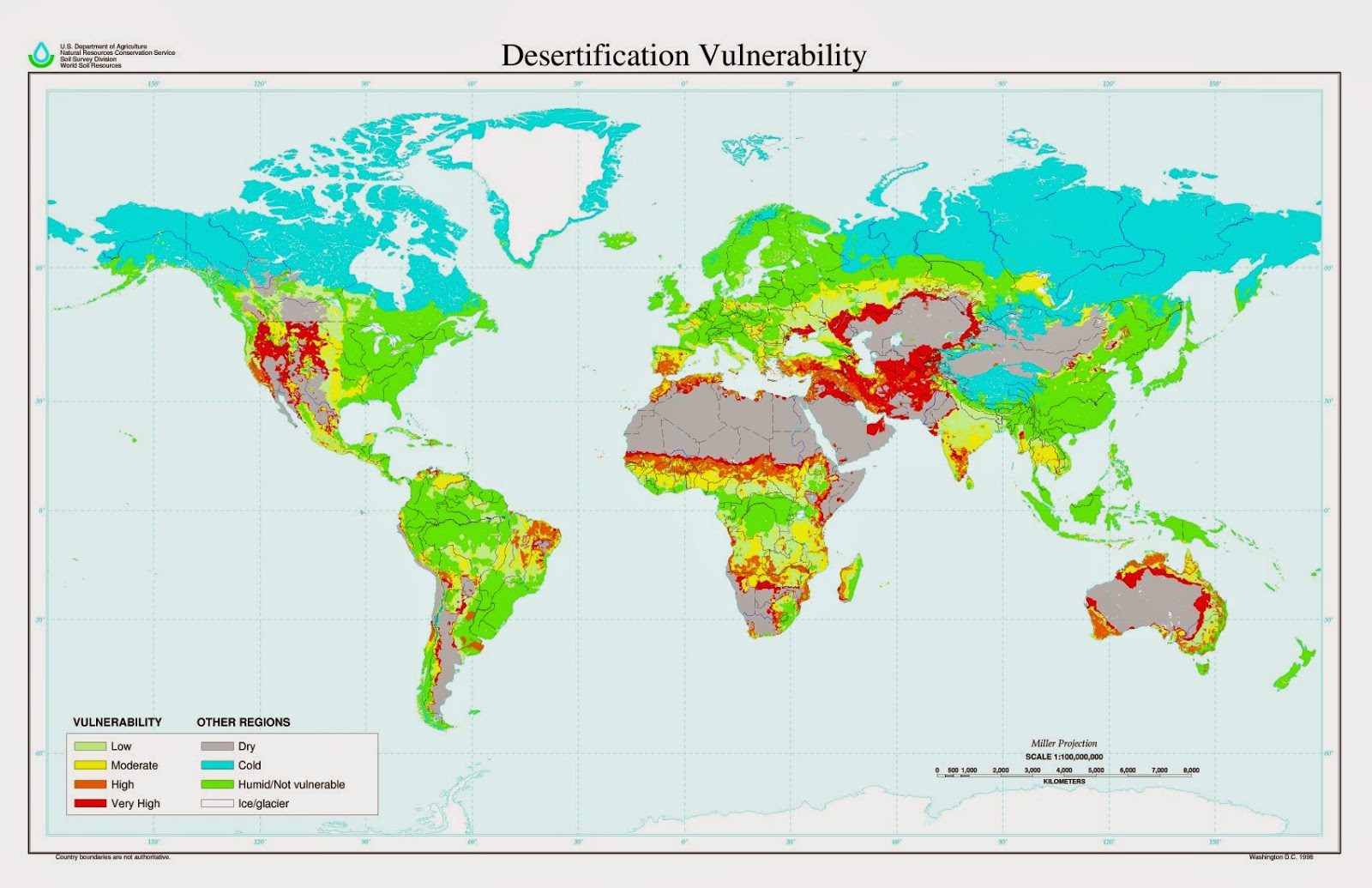
the garbage. As the diagram below
indicates, areas surrounding now desert land (marked in red) are at high risk
of desertification, these areas often belong to small countries who are highly
dependent on their agricultural use and whose desertification will only cause a
ripple effect of increased dependence and indebtedness on agricultural land
belonging to more economically wealthy countries.
 |
| Copyright: http://upload.wikimedia.org/wikipedia/commons/6/68/Desertification_map.png |
The results of a study
undertaken by A. Challinor in 2010 suggests that for China, “climate change will result in increasing spring wheat crop failure in
northeast China due to increasing extremes of both heat and water stress.”
Now according to this
quotation, that study correlates with the image above, where North-east China
is at high risk of desertification. There has also been a lot of coverage on
rice crop failures in China and the millions of tonnes of GHG’s released as a result of this. Although there are ideas being developed
to create heat-resistant and drought-resistant crops, the real answer is right
in front of us and within reach. Following the FAO report cited earlier, the
FAO provided a free toolkit on reducing our food wastage footprint.
 |
| Copyright: http://www.rmaf.org.ph/userfiles/ images/profile_pictures/F/fukuoka.jpeg |
Another view of
desertification which I would like to touch on is that of Masanobu Fukuoka. I
recently read a book of his, One Straw Revolution which spoke of his
system of natural farming where crops could be grown without plowing his
fields, using no prepared fertilisers or agricultural chemicals and did not
flood his rice fields as farmers in Asia continue to do. A method which he
himself developed and lived by for over 65years and in fact yielded greater
quantities of crops than the most productive farms in Japan. This book is
highly relevant to the individual and although delves into some technicality,
Fukuoka’s book serves a far greater purpose than farming
methods. However it is his second and last book which I find so relevant to
this topic of desertification, called Sowing Seeds in the Desert. Although Fukuoka’s influence has been only marginal so far, the increased rate of
desertification begs us to look at alternative possibilities, which include a
return to simple but effective methods of farming. Fukuoka reminds us that the
present state of our land is not natural but rather a result of our own
destructive actions, his silver-longing however, is it can be remedied and
perhaps eventually reversed. HIs aspiration was to achieve “global food security” by natural farming which he practiced and preached in Africa, India,
Southeast Asia, Europe and the United States.
Fukuoka offers us an opportunity to put aside our guilt as we face this
earth’s degradation and take a step forward in the right
direction.
Una Quinn
Thursday, May 29, 2014
Ecotourism...creating a positive change

Ecotourism is defined as "responsible travel
to natural areas that conserves the environment and improves the well-being of
local people." (TIES, 1990) The International Ecotourism Society is a non-profit organisation with members in over
120 countries. They promote awareness of sustainable practice in the tourism
sector, and provide guidelines on standards, training, technical assistance and
educational resources. In the decade between the Earth Summit in 1992 and
the International Year of Ecotourism in 2002, a web of over 100 certification
and award programs appeared, (most of which are of varying quality).
The World Ecotourism
Summit (WES) is organized by UNEP and the World Tourism
Organisation (UNWTO) aiming to strengthen ecotourism as a tool for sustainable development
and conservation. Separately, the World Ecotourism Conference
aims to provide a networking platform for businesses and policy makers, but
with little apparent impact. The European Ecotourism Network
(EEN) and the European Ecotourism Labeling Standard (EETLS), which is co-funded
by the European Commission, has been recognized by the Global
Sustainable Tourism Council (GSTC) and in
comparison with WEC and WES, there is more focus on certification and
standardization. However, there is no single ruling body for global ecotourism
certification, and this has inevitably led to considerable controversy
and uncertainty. As it stands, the GSTC appears to be the most
credible.
The Green Globe
Standard was one
of the leading certification bodies to come out of the Earth Summit in 1992 and
is based on the following international standards and agreements: GSTC, Global Partnership for Sustainable Tourism Criteria (STC
Partnership), Sustainable Tourism Certification Network of the Americas, The ISO 9001/14001/19011 (International
Standard Organization) and Agenda 21. EcoAustralia, in
conjunction with Green Globe, has proven to be a successful international
standard and has also employed in India.
Basic ecotourism principles:
- Sustainable management e.g. design and construction, health and safety and communications.
- Socio-economics e.g. supporting local community initiatives such as education, fairly traded goods and securely integrated local employment.
- Cultural heritage e.g. protection of historical, archaeological and spiritual sites and respectful incorporation of local culture.
- Environmental e.g. sustainable management of water, energy, waste and protection and awareness of biodiversity.
Case Study – Lapa Rios Eco-lodge, Costa Rica
 In 1993, a professional couple from Minnesota
liquidated their assets and bought 930 acres of rainforest in the south west of
the country. In 2013, they signed an agreement endorsed by The Nature
Conservancy and CEDARENA that perpetually protects the land as a primary
forest. It neighbors a National Park, which is home to 2.5% of the world’s
biodiversity and acts as a migration corridor.
In 1993, a professional couple from Minnesota
liquidated their assets and bought 930 acres of rainforest in the south west of
the country. In 2013, they signed an agreement endorsed by The Nature
Conservancy and CEDARENA that perpetually protects the land as a primary
forest. It neighbors a National Park, which is home to 2.5% of the world’s
biodiversity and acts as a migration corridor.
Although Lapa Rios eco-lodge is a leading example
of ecotourism, it has not been certified by organisations such as Green Globe.
Instead, they are certified by the Costa Rican tourism board agency known as
the Certification
for Sustainable Tourism (CST), following similar
principles outlined above. The CST has been recognized and approved by the
tourism ministries in every country in Central America, as well as Mexico,
Belize and many countries in South America have expressed interest in
developing similar programs. Learn more about Lapa Rios here.
It is evident
that ecotourism can and does create real positive change, even when it operates
outside of well-intentioned conferences, however, many resorts will often use it
as a buzzword to attract gullible travellers, so beware!
Conor Dolan
Thursday, May 15, 2014
Eating Insects To Save The World, Don’t Let It Bug You!
 |
| Source: http://www.ibtimes.com/cupcakes -made-insects-food-thought-photos-555117 |
Minestrone with buffalo worms and mealworms
(grasshopper garnish optional); termite porridge; ‘land shrimp snack’ made of
grasshoppers or locusts with hot pepper oil, lime and salt and protein bars
made with cricket flour. These are just a handful of recipes from “The Insect Cookbook: Food For a Sustainable
Planet” published by Dutch entomologists Arnold van Huis and Marcel Dicke,
along with cooking instructor Henk van Garp[1].
The books main aim is to open our eyes to the fact that our aversion to insects
as a food source is senseless and outdated. Unlike livestock and other forms of
animal protein, insects are plentiful and nearly everywhere. Whilst, culturally
we tend to overlook the possibility of caring for ourselves by insect means,
they are a nutrient-rich and sustainable food-source that deserve
consideration.
Jon Foley, head of the Institute for the
Environment at the University of Minnesota, recently referred to the global
food crisis as ‘the other inconvenient truth’ stating that he believes we are
at a ‘critical crossroads’. Currently, the population of the world increases by
about 75 million people each year. According to the United Nations Panel on
Global Sustainability, the world will need at least 50% more food and 30% more
water by 2030[2].
As developing countries adapt to modern needs and their economies grow, their
demand for meat will increase and to meet this we will need to triple our food
production. Unfortunately with current agricultural practices this is an
impossible goal.
 |
| Source: http://finedininglovers.cdn.crosscast- system.com/ImageAlbum/3216 /original_694-a.jpg |
A recent report issued by the U.N.’s Food
and Agriculture Organization (FAO) promoted human consumption of insects as an
environmentally sustainable means of feeding the planet. Although it was met
with disgust and tossed aside by many, others such as food expert, Ruth Reichl,
former editor-in-chief of Gourmet and
award winning author recently told the New
York Times that “We should all be eating insects, and we all will be eating
insects. They are a perfectly reasonable source of protein.” Like it or not, eating insects (or
entomophagy) provides a far more sustainable source of protein than our
existing consumption of meat and animal products. Also, most edible insects are
very protein rich while being comparatively very lean. For example, a cricket
has all the essential amino acids that beef contains but is far higher in iron
and calcium. Other insects can provide other micronutrients such as B-vitamins,
beta-carotene, and vitamin E.
Not only are insects often more
nutritious but they are also a potential solution to the current inefficient
food system because of their marginal environmental impact. In general, insects
are extremely inexpensive and relatively safe and only require a fraction of
the feed, space, water and maintenance of conventional livestock. The current livestock
industry is estimated to be responsible for 17-18% of greenhouse emissions and
accounts for 70% of all land cleared for agriculture[3].
Almost half of global water is used to produce animal-based foods. Insects, on
the other hand, can live off agricultural byproducts such as food waste (e.g.
fruit peels) and only a tiny portion of them produce methane, with those that
do only producing very small amounts. Also as insects are poikilothermic (i.e.
their body temperature remains the same as their surroundings), they are much
more efficient at converting nutrition into protein. For instance, crickets
need 12 times less food than cattle to produce the same amount of protein and
unlike the cruel practice of factory farming, crickets and other bugs actually
thrive when they are packed on top of each other[4].
Convinced yet?
With an estimated 1417 species of insects
being regularly eaten by over 2 billion people across 3,000 ethnic groups in
80% of countries around the world, it seems it is the Westerners who will
suffer most in the long run. But why are we so squeamish when it comes to the
idea of chomping down on nice slice of crittle (a cricket and peanut brittle
hybrid)?
Most of the Western world readily eats
prawns and shrimp, which are arthropods-just, like insects, spiders and
millipedes! Therefore, we need to get over this idea that insects are
disgusting and stop trying to live in an insect-free world where everything is
sterile and clean (after all we wouldn’t be here without the pollinating
insects!). But before you get too excited and run down to the local park with a
homemade pooter, take heed of the following advice. Like plants, some insects
are good for you and some are toxic, aswell as the fact that you can never be
sure that wild insects haven’t been exposed to pesticides, therefore, only
farmed insects should be consumed. There are also several ‘pestaurants’ opening
up around the world with a variety of insects to suit every palate. Experts also
caution that we must be careful to develop sustainable cultivation and
harvesting methods, as there are examples of human overconsumption that has led
to the collapse of some insect species.
Jakub Dzamba, a man who’s researching
radical approaches to urban agriculture, is working to build insect farms that
can go right into the walls of an apartment building. The idea is that families
could feed their food scraps and leftovers to the crickets, and then eat those
same crickets, thus solving the dual agricultural problems of production and
distribution. It would therefore
seem that these six-legged critters might just find a spot at our table in the
not-so-distant future. If we can just start to accept and overcome our fear of
munching on food that creeps and crawls, the future looks a little brighter for
us humans. Unfortunately, I’m not so sure the same can be said for the future
of our possible new food source, who have more of a reason now than ever, to
stay away from the ‘light’!
Subscribe to:
Posts (Atom)