This blog was originally based on a course ran by Professor Nick Gray of the Trinity Centre for the Environment at Trinity College Dublin who also wrote a textbook for the module Facing up to global warming: What is going on and what you can do about it. Now working as an independent consultant, Nick continues to work in the area of environmental sustainability and looking at ways of making a difference without recriminations or guilt. Saving the planet is all about living sustainably.


Showing posts with label Food. Show all posts

Friday, October 16, 2015

World Food Day


Today is World Food Day which highlights the urgent issue of chronic hunger and promotes positive action through events in some 150 countries.  Follow the action on the web or  on Twitter

About 795 million people are undernourished globally, down 167 million over the last decade, and 216 million less than in 1990–92. The decline is more pronounced in developing regions, despite significant population growth. In recent years, progress has been hindered by slower and less inclusive economic growth as well as political instability in some developing regions, such as Central Africa and western Asia.

Read more in the latest FAO Report The State of Food Insecurity in the World


Posted : Nick Gray https://twitter.com/Nickgraytcd

Thursday, September 24, 2015

Facing Up To Global Warming Published

Facing Up To Global Warming: what is going on and how you can make a difference?


This new book was published today and  explores climate change and how individuals can make a difference. 

 Below is the Preface from the new book.


In 1972, a startling book was published called Limits to Growth . This book became hugely influential in the environmental movement, and while it alerted us to the fragility of our future on planet Earth, it also, inadvertently, helped to eventually undermine the credibility of environmentalism. The book predicted when certain non-renewables, including fossil fuels and metals, would become exhausted. The predictions were based on the best available knowledge at that time, but what it never envisaged in the early 1970’s, was that within a decade humans would be extracting oil, gas, and minerals in some of the remotest, extreme, and fragile places on Earth … a process that has continued and expanded to the present day. So the predictions proved incorrect in practice, but it reinforced the idea that all resources are limited and are slowly being exhausted.

This book became a driving force for many environmental scientists who realized that we have to act both collectively and individually to preserve our home, planet Earth, with its unique biosphere and which is home to millions of different living organisms of which we are just one species. For me personally, being an environmental scientist has been a long and often disappointing journey and at various times I have been shocked, scared, and often depressed by the unfolding of the current crisis which is so intertwined with global warming. But, to my surprise, in recent years I have begun to feel more hopeful that perhaps we can deal with our climate and resource problems to create a sustainable planet. So in this book, I have attempted to explain what the problems are and suggest some solutions. However, the book comes with a warning. During the 15 chapters that follow, I am going to make a lot of you really annoyed and possibly upset, I apologize in advance. I am not trying to shock; I am simply putting the facts before you so that you can make up your own mind. Neither am I telling anyone that their lifestyle is wrong, or alternatively, that they are better than the next person because they have invested in green energy or a hybrid car. The book is an overview; it is not a text on the theory of sustainability or population dynamics; it simply looks at what the individual should know and addresses some of the issues closest to our everyday lives.

There are hundreds of academic and specialist texts on sustainability, but they fail to link sustainability to tackling global warming, especially at the individual level. Adopting any form of sustainable actions in your life will cause significant effects both direct and indirect. Such actions will lead to changes that will influence economic and social norms … so sustainability if properly applied will mean socio economic change. I begin the text by giving a brief overview of the problems of climate change and the real difficulties that having such a rapidly growing population is placing on the idea of a sustainable and equitable planet. Discussions on population is always a very emotive issue and so I have simply given some basic facts, and shown that as population grows our ability to live sustainably on planet Earth becomes more challenging. So this is not a comfortable book.

Is the text political? I have tried not to be, but if you advocate changing people’s lifestyles, then it will appear to be political. Then, we have the concept that everyone on the planet matters and that the concept of global justice and human rights is important when assessing the sustainability of our own lifestyles. So trying to avert these climate-mediated crises by ensuring that everyone has enough for their needs without being wasteful is a good starting point. However, that starting point has to be an acknowledgment that all people are equal, and that we should all have the right to pursue happiness and well-being. Is this naïve? Of course it is, but what else are we to strive for in a truly global and fair society. Global warming raises serious social as well as economic questions and many of these are going to be very difficult to deal with in practice, and my aim is to try and make you think about these issues from a personal perspective. Can we have finite economic growth? Can we have finite consumerism? Unfortunately, the answer has to be no to both of these questions, which means that both economists and social geographers or planners have a lot of work to do and that we are going to have to eventually reinvent our economy and social environment to achieve these goals.

There are also many other important environmental issues that we also need to consider and many of these are also linked to global warming such as deforestation, exploitation of new fossil fuel reserves, intensification of agriculture, and overexploitation of water resources. However, many of these issues such as pollution, are less important in the context of global warming, as we now have them largely under control. We have made huge strides in dealing with air, water, and land pollution over the past 40 years, and there are scientists and regulatory bodies all dealing with these issues on an on-going basis. Such issues are predominately local or at worst regional, but rarely global, and what is important is that we have the technology and infrastructure to deal with them. But controlling carbon dioxide and other greenhouse gas emissions must now be everyone’s priority. If we have to reduce carbon emissions by 80 % by 2050 to avert a global crisis, this will mean using significantly less energy in the developed world than we currently use, and while this does not necessarily mean an immediate and huge change in our everyday lives, it does mean changes to our current lifestyles. This is not going to be easy and the burden has to be shared by everyone. However, the fact is that people feel very threatened by the idea of altering their lifestyle, even when change can be for the better. 

We also need to understand that some sectors of society are using more than their fair share of global resources, but that in the context of global warming everyone must act responsibly if we are to succeed in mitigating climate change. Those in developing countries also desire the technology, food, travel, etc. we enjoy, and to break this cycle we in the developed world need to begin to pull back from our current high-energy lifestyle while allowing the poorer nations to develop and become sustainable.

This book will never be welcomed by those who are pretty happy with the status quo and who have not become genuinely concerned, possibly scared, by the possibility of what global warming may do to our home, planet Earth. This is a very general text that looks at different aspects of our lives which we, as individuals, have control over. It is simple things like travel, food, recycling, using resources … all those things which we are all involved in on a daily basis; and how our actions affect the future of planet Earth and our ability to sustain that ever growing human population. I hope that this book will help you think and act from a position of knowledge and reassurance.

I hope that the majority of you will be reassured that we are beginning to tackle global warming successfully, but in order to succeed in stabilizing our new climate, and I believe we can, we need your help through direct action. You really can make a difference. This book is a personal journey and during it I will be asking you to do various things. Some are critical others will be just things that I hope you will try, but to work, I need a commitment from you. The journey is not free, it comes at a cost, and you have to decide just how much you are willing to pay for your planet.


This is about your future.
Nick Gray
Trinity Centre for the Environment

Thursday, June 26, 2014

Glaring signs of active desertification and the hopeful yet strategic words of a wise man

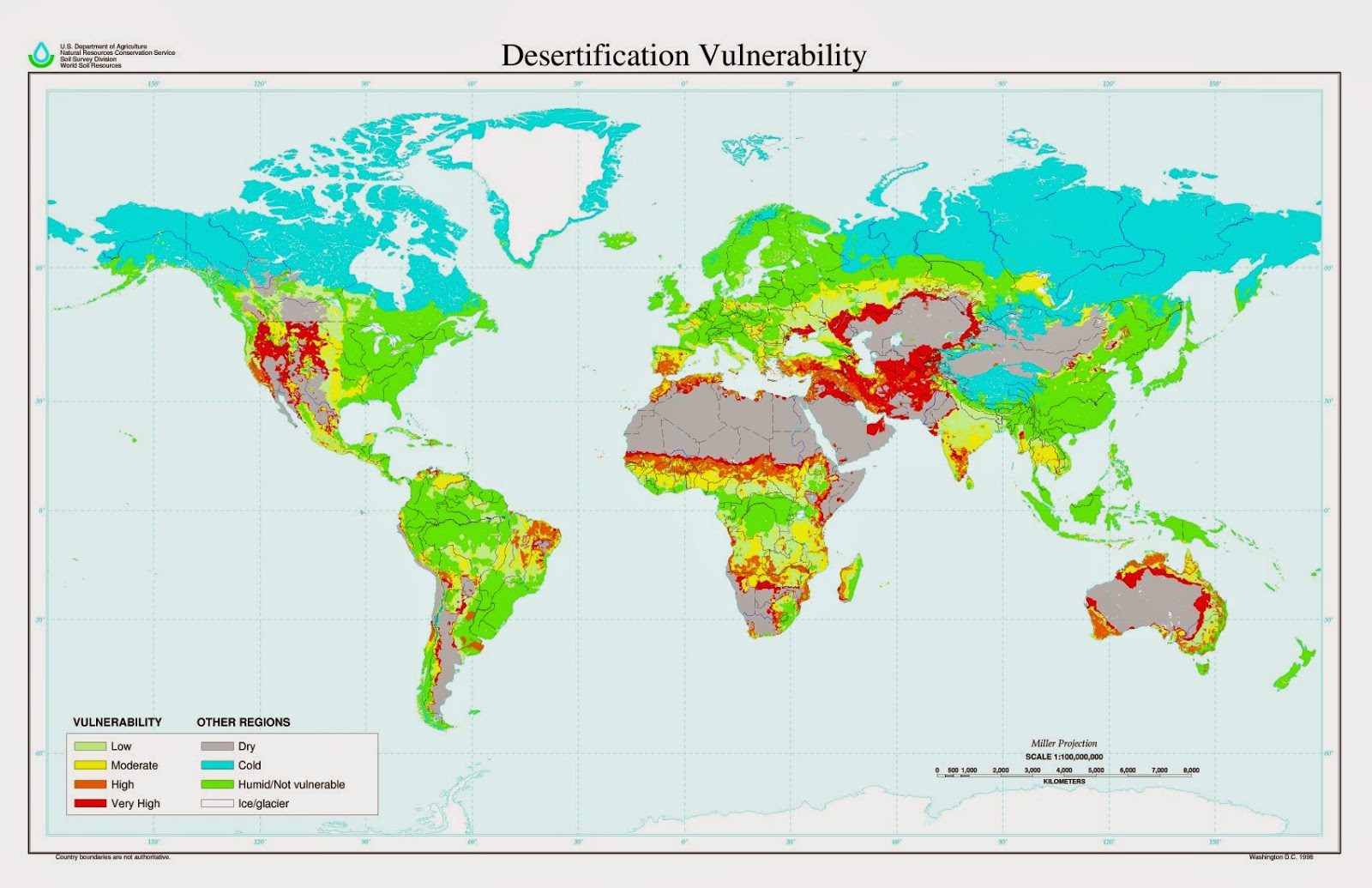
A recent report entitled UN report: one-third of worlds food wasted annually, at great economic, environmental cost sparked in me a concern over land usage and destruction caused by our very own food wastage. Our wasted food accounts for a staggering 28% of the worlds agricultural area or 1.4billion hectares.  All of which ends up in our bin. The article discusses a recent report published by the FAO on our Food Wastage Footprint. With the drastic spreading of desertification, we simply cannot afford to allow 28% of our fertile land produce to be thrown in the garbage. As the diagram below indicates, areas surrounding now desert land (marked in red) are at high risk of desertification, these areas often belong to small countries who are highly dependent on their agricultural use and whose desertification will only cause a ripple effect of increased dependence and indebtedness on agricultural land belonging to more economically wealthy countries.
Copyright: http://upload.wikimedia.org/wikipedia/commons/6/68/Desertification_map.png


The results of a study undertaken by A. Challinor in 2010 suggests that for China, climate change will result in increasing spring wheat crop failure in northeast China due to increasing extremes of both heat and water stress. Now according to this quotation, that study correlates with the image above, where North-east China is at high risk of desertification. There has also been a lot of coverage on rice crop failures in China and the millions of tonnes of GHGs released as a result of this. Although there are ideas being developed to create heat-resistant and drought-resistant crops, the real answer is right in front of us and within reach. Following the FAO report cited earlier, the FAO provided a free toolkit on reducing our food wastage footprint.

Copyright: http://www.rmaf.org.ph/userfiles/
images/profile_pictures/F/fukuoka.jpeg

Another view of desertification which I would like to touch on is that of Masanobu Fukuoka. I recently read a book of his, One Straw Revolution which spoke of his system of natural farming where crops could be grown without plowing his fields, using no prepared fertilisers or agricultural chemicals and did not flood his rice fields as farmers in Asia continue to do. A method which he himself developed and lived by for over 65years and in fact yielded greater quantities of crops than the most productive farms in Japan. This book is highly relevant to the individual and although delves into some technicality, Fukuokas book serves a far greater purpose than farming methods. However it is his second and last book which I find so relevant to this topic of desertification, called Sowing Seeds in the Desert. Although Fukuokas influence has been only marginal so far, the increased rate of desertification begs us to look at alternative possibilities, which include a return to simple but effective methods of farming. Fukuoka reminds us that the present state of our land is not natural but rather a result of our own destructive actions, his silver-longing however, is it can be remedied and perhaps eventually reversed. HIs aspiration was to achieve global food security by natural farming which he practiced and preached in Africa, India, Southeast Asia, Europe and the United States.  Fukuoka offers us an opportunity to put aside our guilt as we face this earths degradation and take a step forward in the right direction.

Una Quinn


Thursday, May 15, 2014

Eating Insects To Save The World, Don’t Let It Bug You!

Source: http://www.ibtimes.com/cupcakes
-made-insects-food-thought-photos-555117
Minestrone with buffalo worms and mealworms (grasshopper garnish optional); termite porridge; ‘land shrimp snack’ made of grasshoppers or locusts with hot pepper oil, lime and salt and protein bars made with cricket flour. These are just a handful of recipes from “The Insect Cookbook: Food For a Sustainable Planet” published by Dutch entomologists Arnold van Huis and Marcel Dicke, along with cooking instructor Henk van Garp[1]. The books main aim is to open our eyes to the fact that our aversion to insects as a food source is senseless and outdated. Unlike livestock and other forms of animal protein, insects are plentiful and nearly everywhere. Whilst, culturally we tend to overlook the possibility of caring for ourselves by insect means, they are a nutrient-rich and sustainable food-source that deserve consideration.

Jon Foley, head of the Institute for the Environment at the University of Minnesota, recently referred to the global food crisis as ‘the other inconvenient truth’ stating that he believes we are at a ‘critical crossroads’. Currently, the population of the world increases by about 75 million people each year. According to the United Nations Panel on Global Sustainability, the world will need at least 50% more food and 30% more water by 2030[2]. As developing countries adapt to modern needs and their economies grow, their demand for meat will increase and to meet this we will need to triple our food production. Unfortunately with current agricultural practices this is an impossible goal.

Source: http://finedininglovers.cdn.crosscast-
system.com/ImageAlbum/3216
/original_694-a.jpg
A recent report issued by the U.N.’s Food and Agriculture Organization (FAO) promoted human consumption of insects as an environmentally sustainable means of feeding the planet. Although it was met with disgust and tossed aside by many, others such as food expert, Ruth Reichl, former editor-in-chief of Gourmet and award winning author recently told the New York Times that “We should all be eating insects, and we all will be eating insects. They are a perfectly reasonable source of protein.”   Like it or not, eating insects (or entomophagy) provides a far more sustainable source of protein than our existing consumption of meat and animal products. Also, most edible insects are very protein rich while being comparatively very lean. For example, a cricket has all the essential amino acids that beef contains but is far higher in iron and calcium. Other insects can provide other micronutrients such as B-vitamins, beta-carotene, and vitamin E.

Not only are insects often more nutritious but they are also a potential solution to the current inefficient food system because of their marginal environmental impact. In general, insects are extremely inexpensive and relatively safe and only require a fraction of the feed, space, water and maintenance of conventional livestock. The current livestock industry is estimated to be responsible for 17-18% of greenhouse emissions and accounts for 70% of all land cleared for agriculture[3]. Almost half of global water is used to produce animal-based foods. Insects, on the other hand, can live off agricultural byproducts such as food waste (e.g. fruit peels) and only a tiny portion of them produce methane, with those that do only producing very small amounts. Also as insects are poikilothermic (i.e. their body temperature remains the same as their surroundings), they are much more efficient at converting nutrition into protein. For instance, crickets need 12 times less food than cattle to produce the same amount of protein and unlike the cruel practice of factory farming, crickets and other bugs actually thrive when they are packed on top of each other[4]. Convinced yet?

With an estimated 1417 species of insects being regularly eaten by over 2 billion people across 3,000 ethnic groups in 80% of countries around the world, it seems it is the Westerners who will suffer most in the long run. But why are we so squeamish when it comes to the idea of chomping down on nice slice of crittle (a cricket and peanut brittle hybrid)?

Most of the Western world readily eats prawns and shrimp, which are arthropods-just, like insects, spiders and millipedes! Therefore, we need to get over this idea that insects are disgusting and stop trying to live in an insect-free world where everything is sterile and clean (after all we wouldn’t be here without the pollinating insects!). But before you get too excited and run down to the local park with a homemade pooter, take heed of the following advice. Like plants, some insects are good for you and some are toxic, aswell as the fact that you can never be sure that wild insects haven’t been exposed to pesticides, therefore, only farmed insects should be consumed. There are also several ‘pestaurants’ opening up around the world with a variety of insects to suit every palate. Experts also caution that we must be careful to develop sustainable cultivation and harvesting methods, as there are examples of human overconsumption that has led to the collapse of some insect species.

Jakub Dzamba, a man who’s researching radical approaches to urban agriculture, is working to build insect farms that can go right into the walls of an apartment building. The idea is that families could feed their food scraps and leftovers to the crickets, and then eat those same crickets, thus solving the dual agricultural problems of production and distribution.  It would therefore seem that these six-legged critters might just find a spot at our table in the not-so-distant future. If we can just start to accept and overcome our fear of munching on food that creeps and crawls, the future looks a little brighter for us humans. Unfortunately, I’m not so sure the same can be said for the future of our possible new food source, who have more of a reason now than ever, to stay away from the ‘light’!

Tuesday, July 2, 2013

Dinner’s on me

The food we eat everyday forms a critical component of our carbon emissions. How we get this food and what we do with the waste form the integral part of this problem.While as consumers we have limited control over the agricultural practices, food wastage is entirely down to us. What makes this problem even more dramatic is the fact that food wastage is a completely unnecessary and avoidable in today’s modern world. Coming from an agricultural background and working part time in a local supermarket, I have experienced first-handthe huge wastage that exists among society today.
According to the Department of Agriculture’s websites, 29% of Irelands total national carbon emissions in 2009 came from the agricultural sector while food wastage accounted for approximately 15 million tons of CO2emissions each year in the UK.  This area urgently needs to be addressed. Working part time in my local supermarket has given a prime insight into the food wastage that occurs there on a daily basis. Date checks have to be carried out on all products on a daily basis. When most products near their expiry date they are marked down in price, however meat and dairy products have to be removed a day before their ‘best-before’ or ‘use-by’ date, resulting in huge wastage. These products are simply thrown in the bin. Similarly, living on a farm has given me an insight into the wastage that occurs before products even reach the shops. Many perfectly healthy vegetables are deemed to be ‘unsellable’ due to their unusual shape or appearance. While food is wasted every day in first world countries such as Ireland, 239 million people in Africa go hungry every year.
Now that we are aware of the problem, what can be done in order to obtain our food in a more sustainable manner? Examples of sustainable initiatives at a nationwide level include:
·         In America, food collecting organizations have been established and collect food from restaurants, supermarkets and cafeterias that would otherwise be thrown out and distribute it to low income families and the homeless. If a similar plan was adopted in Ireland it would significantly reduce food wastage in supermarkets across Ireland.
·         Since the fall of the Celtic tiger in Ireland, there has been a growing trend towards allotment gardening where people can grow their own fruit and vegetables. I was interested to learn during the Living Sustainably course that anything grown in an allotment or garden in season is equal to 0g CO2e kg-1.If county councils across Ireland committed to supplying land for allotment gardening, carbon emissions would be significantly reduced.
·         In response to the emissions from agriculture, the Department of Agriculture has committed to a plan of planting new forests and maintaining good forest management in order to counteract CO2 emissions.
However real change is needed at the basic human level and it is up to each and every one of us to change our consumer habits to ensure a sustainable planet for the future.  By committing to buying only the food we really need, to buy food that is locally produced and in season and by avoiding unnecessary food packaging we can make a big difference to the planet.
 Additional Information can be found on:
·         http://www.allotments.ie/
·         http://www.agriculture.gov.ie/

Paul

Sunday, June 30, 2013

Quality v. Quantity: Mindful Living...or Frugality often gets a bad rap.

 Frugality often gets a bad rap.
Why is it that so often living “frugally” is often linked mentally with want, deprivation and hardship?  Mention the word and immediately people conjure up archaic images of teabags drying on radiators, cold showers and penny-pinching, when in reality frugality is essentially a means of achieving a quality lifestyle and fulfilling the needs of the individual in society, whilst leaving minimum negative impact on community, the planet and its resources. Admittedly, the word frugal itself is hardly the most onomatopoeically-endearing of the English language, but it does certainly does lend a solid air of reality which encompasses the essence of what frugal living is about.  For me, being frugal is a means of directing the materials and resources available to me towards a goal which I want to achieve, enabling me to complete such tasks in a less wasteful, more efficient and thoroughly-considered fashion.  In no sense do I consider there to be any level of deprivation; in fact I think cutting the clutter and distraction from ones life allows for greater clarity to shine through, enabling one to visualise plainly what are the real essentials in life and how best to go about maintaining these.  In the overwhelmingly materialistic, consumer-driven society in which we live, more and more excesses of all has lead to a devaluing of quality in favour of inferior quantity.  Here frugality can act as a life raft in the sea of superfluousness, a wake-up call forcing us to examine what matters.  Giving a brief run-down through this topic does not do it justice as by its very nature greater depth of thought is required, but frugal living can be broadly addressed in three main sections:  the why, the how and the outcome.
Frugal living is a sustainable way of life and can be viewed as a way of guaranteeing, to the best of one’s ability, that the life one leads is truly meaningful.  My own personal definition of sustainability would run something like: “Sustainability is the thought process behind mindfully living a considered life, endeavouring to maintain an equilibrium between personal development, integrity, and responsibility, such that the needs of future generations are not compromised through mismanagement of the earth’s resources by present generations.”  Lofty ideals you may think, but unless one strives toward an upward goal there would certainly be no motivation to continue on.  In the case of any goal that requires longevity, soundly-founded motivations need to be established before anything is ventured and frugal sustainability is no different.  We need to ask ourselves “Why should I do this?  What are the benefits to me personally and what are the benefits to the wider community?  Am I ready to accept that my personal decisions can and will have a large impact on those around me?”. If these questions can be answered honestly and solidly there will be sufficient motivational undercurrents to sustain one through the practical implementations of frugal living.  Starting small and incorporating small changes on a day-to-day basis, great success can be accomplished through the setting of many small, realistic and achievable goals. 
Avoiding procrastination is a definite requirement for living the frugal lifestyle, but once this reality is accepted as a hitherto-unrecognised benefit, the sky’s the limit for the creative ways in which frugality can be lived out, making your time, money and resources work hardest for you.  From practical applications such as reducing waste in the home, buying less consumer goods and increasing productivity by utilising goods to the very end of their product-life, to more fun and unique approaches such as going on self-imposed spending ‘diets’, enjoying frugal freezer-food meals and trying out ‘Meatless Mondays’.  Certainly we must realise that there is no one magic-bullet, simplistic route to achieve these goals, but we need to take every small avenue available to us, making numerous small changes.
The outcome of embarking on the frugal living path is that it allows for greater personal freedom.  Less “stuff” means a reduction in time and energy consumed whilst absorbed in (or perhaps burdened with) said “stuff”. We are afforded more time to reflect and think on our life-goals.  We are mindfully conscious of what we are doing and why we are doing it.  Savouring experiences and enjoying simple pleasures are incomparably more fulfilling than rushing through a series of tick-the-box life goals set up on a scale belonging to the Joneses.  Paring back the excess allows us to appreciate all the more how rich we really are – after all, our attention is no longer divided in multiple different ways but rather we are free to focus and enjoy the delights of a smaller number of better-curated occupations.  Each of us are the cultivator of our own person and our personal development, which in turn is amplified and combined with that of others to create the societies in which we live.  We have the right to enjoy this, but more importantly we have the responsibility to do so - not only for our own sakes’ but for the sake of our fellow man and frugal living is a powerful way to do so.

Sunday, May 26, 2013

In-Vitro Grown Meat - a low carbon alternative?

Which scene do you think is more appealing? Lush green pastures, covering dozens of acres, filled with grazing cattle - or muscle cell culture, floating in a petri dish flooded with growth hormones, nutrients and stimulants. The end result of both: the beef burger you're going to chow down on for dinner. Easy decision, right?

Image source
http://uk.reuters.com/article/2011/11/11/uk-science-meat-idUKTRE7AA1Z020111111
Not so fast - there’s more to this “lab meat” than it initially seems. In-vitro meat – grown from animal tissue in an indoor setting - has the potential to be just as palatable and tasty as the "real deal".  The potential industry revolution has been garnering more and more attention in recent years: in 2011, PETA announced an award of $1 million to whoever managed to produce meat from cell culture which is as good as the meat from a whole animal (1). Though currently too expensive for the average person - a meat for a beef burger currently costs about £200,000 (2) - the costs will eventually drop, allowing those who find meat eating morally reprehensible finally have that steak they've been dreaming about for years.

But there is more than just an ethical benefit in replacing traditionally-grown red and white meat with the in-vitro variant.  The live meat industry is a massive contributor to global environmental change; it is responsible for 18% of greenhouse gas emissions, takes up 2/3 of agricultural land, and costs 2500-5000 gallons of water per pound of beef produced (3,4). Clearly, reducing our meat and dairy consumption is a simple but significant change that each individual could take to reduce one's carbon footprint. But in-vitro meat is an interesting alternative; the production method results in less greenhouse gas emissions, requires less energy and could reduce emissions at other points in the supply chain. A recent study by Tuomisto and de Mattos (5 - include a diagram, possible?) estimated that lab-grown meat would require 99% less land use, 82-96% less water consumption, 78-96 less greenhouse gas emissions, and 7-45% less energy per volume of pork, beef and sheep (poultry would require more energy but much less land  and water). Though these figures are built on many assumptions, technological innovations could meet these targets. Meat appears to be back on the menu in our environmentally-turbulent world.

The possibilities of in-vitro meat do not end there. Meat could be produced in urban environments and delivered rapidly to food distributers and shops, reducing the eco-burden of shipping and transportation from the source of production. The monetary and energy costs of freezing the product would be reduced also, as excess fats and bone would not need to stored. More savings could be made by "vertical farming" - high rise buildings devoted to the indoor production of food stuffs in urban environments (6). These "food factories" aim to be as efficient as a normal ecosystem, recovering water by hydroponics and aeroponics. Though conceived of as being a means to locally source fruit and vegetables in cities or town, combining the concept with in-vitro meat culturing has the potential to curb the environmental impact of overall food consumption.

Reducing food wastage and the consumption of meat and dairy products is an effective way we can reduce greenhouse gas emissions. But unfortunately not everyone is willing to sign up for the vegetarian lifestyle for the sake of environment. In-vitro culturing gives us a chance of a future where environmental change is under control but the humble hamburger remains – even if it were grown in a test tube.

Kevin Daly

References:
1. http://www.independent.ie/business/farming/peta-offers-1m-for-invitro-meat-26720454.html
2.http://www.bbc.co.uk/news/science-environment-16972761
3. http://woods.stanford.edu/environmental-venture-projects/consequences-increased-global-meat-consumption-global-environment
4. http://www.earthsave.org/environment/foodchoices.htm
5. Environmental Impacts of Cultured Meat ProductionEnviron. Sci. Technol., 2011, 45 (14), pp 6117–6123 Hanna L.Tuomisto and M. Joost Teixeira de Mattos
6. http://www.scientificamerican.com/article.cfm?id=the-rise-of-vertical-farms

Friday, May 10, 2013

Reduce your carbon Paw print: Tips for greening up your pet


I can be green too!

In 2009, a couple from New Zealand, Robert and Brenda Vale, wrote a book called ‘Time to Eat the Dog?’ in which they discussed the devastating effect that being careless with how you care for you pet can have on the environment.  According to the book, the carbon paw print of a pet dog is double that of your standard SUV, making man's best friend the environment's worst enemy. Other pets targeted were hamsters, which were compared to a plasma television, and goldfish, which actually burn energy equivalent to two cell phones. With a few small changes to how you care for your animals, you can help reduce your carbon footprint by reducing their carbon paw print.

1: Adopt Pets
There are plenty of lovely pets just waiting in animal shelters to find new homes. As well as doing good, by adopting you are also reducing the demand for pets from mills, which have large carbon footprints due to their use of low-grade food (the production of which has high carbon emissions).
2: Recycle and Reuse
Lend a helping hand. Instead of binning your old toys, beds and accessories when your pet grows out of them (or just tired of them), drop them up to your local pet shelter. Not only is this better for the environment but you will also be helping out very worthy charities. You could also swap old pet accessories among your neighbours or friends who are also pet owners.
3: Pick up Waste
Instead of using plastic bags to pick up your dog waste, opt for biodegradable bags that break down in about a month – a lot better than the 1500 years it takes plastic to degrade. If you have cats, think about switching to an organic, plant-based litter.
4: Walk to Walks
Why drive your dog around to bring them for a walk? Look for parks and open spaces nearer to your house to reduce emissions. If you need to drive, try to carpool with other dog owners.
5: Buy them Green Goods
These days, eco-friendly pet accessories are everywhere. When buying your pets toys, look for toys made from recycled materials or sustainable fibres such as hemp. You can also buy hemp collars and leads, which are much better than the more common plastic or leather. You can also get beds made from organic materials or recycled PET bottles. Failing this, use old towels or cushions to make your own eco-friendly pet bed.
6: Be Careful about Food
When buying pet food, opt for higher-quality foods, which have used sustainable methods and are conscious of their carbon footprint when producing it. Take the time to read the labels on all pet food packaging, and look for foods that do not contain synthetic ingredients or chemically altered natural ingredients. Buy chicken and rabbit flavours over beef, which will also lower your pet’s carbon paw print. As well as this, try your hand at using up scraps of old food and vegetables to make your own dog treats. You’ll save money and also reduce your waste by using up odds and ends and not having excess packaging from store-bought goods. When you are buying pet food, buy in bulk to reduce the packaging.
Ailbhe Smith

Tuesday, April 30, 2013

What the Horsemeat Scandal has Taught Us

 I have no problem eating horsemeat, however, what the recent horsemeat scandal has taught us, is that we can no longer take for granted what we are actually eating or where exactly it is coming from. Not only has this investigation raised questions into both the regulation and traceability of the meat industry in Europe, but it has also highlighted what a globalised and mechanised system the modern food industry is.

Following the discovery by the Food Safety Authority of Ireland that Horse DNA was contained within a third of all tested frozen beefburgers and ready meals, a large-scale enquiry was carried out into the origin of these meat products. The enquiry quickly spread to the UK where products such as frozen spaghetti Bolognese sold in supermarkets including Aldi, Tesco and Findus were found to include 100% horsemeat. It was subsequently discovered that the meat supply chain could be traced back through 8 different companies, located in different countries of Europe including Cyprus, Romania, Luxembourg, the Netherlands and France.

For me, two main aspects have arisen from this scandal. Firstly, in an article written in ‘the Guardian’, it was highlighted that economy beefburgers (cheap, industrialised burgers) are legally allowed to consist of only 47% beef, the remainder made up of protein additives, fat and water (A fact that surely makes the idea of a 100% horsemeat burger suddenly sound a lot more appealing). Secondly, the distance that food is now travelling before it even gets to our plates, a figure that is certainly not decreasing.

In terms of sustainable living, the farm to fork distance is perhaps the most significant aspect that needs to be tackled. In the UK alone, one in four heavy goods vehicles are in fact carrying food. Considering how many tonnes of CO2 emissions could be saved each year if less food was transported such long distances, it is clear to see the potential this area has for drastically reducing our carbon footprints. In the USA this problem has actually worsened. In 1997, the average distance travelled by food stood at 6760 km. However, by 2004 this figure had increased to 8240 km.

By making a greater effort to source local goods as well as promoting seasonal diets, we can not only radically cut down the distance which our food is travelling, but also ensure that a higher level of traceability and quality is delivered for all food products. This will also help in both augmenting the local economy as well as decreasing our carbon footprint. The problem with this ideal however, is ultimately cost related. Although it is much cheaper for us to consume food products bought in supermarkets, the true environmental cost of this practise is often overlooked. The sad reality is, that when faced with a decision of spending a little extra on a locally sourced, 100% Irish beefburger, we will usually choose the cheaper, lower quality option sourced from far afield, attached with a substantial carbon footprint.

As it is simply not economically viable for many people to source the generally more expensive local or even national goods, the government needs to take a more active role in creating incentives for people to buy local. Unfortunately, the irony is that the government itself lacks the money to fund such programmes. Unless the general population recognises the importance of buying local, it looks likely that our future consuming habits will continue to seek out the cheapest option.

Patrick Moss


Reference: 
Lawrence, F. (2013) Horsemeat scandal: the essential guide. The Guardian. 15th February. Available at: http://www.guardian.co.uk/uk/2013/feb/15/horsemeat-scandal-the-essential-guide [accessed 02/04/2013]

Friday, April 26, 2013

Recycling and My Sandwiches

Recycling is one of those things that, in my experience anyway has been drilled into me from a young age. It is something that as I grew older I became complacent with. I went to a primary school which had a green flag and a secondary school which had a strong recycling policy. I won’t sound very academic when I say this but I never really questioned any of it I just recycled because I was told to and admittedly was a bit scared of the consequences if I didn’t. Putting your yoghurt pot in recycling the bin seemed like an easy alternative to a detention.

Now that I am in college and have left all the fear behind I have continued to recycle out of habit but it was only really when I started the living sustainably course that I began to assess what  impact  recycling  can have.  Just looking around college, we as students are producing a lot of waste. I know for me any way I would throw my drinks bottle and paper wrapper from my roll straight into the nearest bin, whether it be recycling or not. Generally speaking it is not!

One of the tasks on this course was to examine the contents of a refuse sack at home.  I live in my family home so as a whole we would produce more waste than the average group of students living in rented accommodation.  This was a seemingly basic task, I remember doing the same in primary school and proceeding to harp on at my mum for her lack of awareness about all things green.  This time I was approaching it in a new light with the understanding that we as a community of inhabitants of the earth really do not look after what we’ve got.

On examining the bin I found a number of things and I have mentioned this in my assessment. Firstly, the general waste bin I found cling film and then aluminum foil. These are both very commonly used household products. Even for those who but lunch when they are in college many sandwiches are wrapped in such packaging.

This may sound silly but I wasn’t sure whether or not these could be recycled. I took it upon myself to check. (This course really has made me interested in the world around me!). It transpires that cling film cannot be recycled everywhere and neither can aluminium foil.  I was shocked at this! Cling film is something that I would have always choses over aluminum foil simply because I believed it would be recyclable and more ecofriendly than aluminium. I’ll admit, this seems like a very small and insignificant discovery but if it were not for this module I wouldn’t have checked.  So my answer is to get a lunch box.

Although a tiny thing I am now more aware of the small changes I can do to avoid contributing to landfill. Something as small as what I chose to wrap my sandwiches in everyday.

I realize I have picked up on a very small issue however out of the whole module I feel it is one thing in particular that felt very relevant to my life and I felt it was something I could deal with straight away.

Naomi Gibson

Monday, April 8, 2013

Plastic makes the world go round...But can we do without it, when we are buying food?

 Once, I was at the airport at a time too early to be mentioned here. So, there was plenty of time to pass before the buses ran again. I decided to sit down at one of those airport restaurants, which already served breakfast, and I bought an on-site prepared smoothie, which was filled into a tiny, resealable plastic bottle. Of course, an unnecessary wrapping for me, because I finished the smoothie there, and a drinking glass would have done an even better job. Then I thought of how much unnecessary plastic wrapping there is, and how many things I just buy to throw them away again.

Back home, what I did next was to check my fridge for the last grocery purchase, which turned out to contain more plastic than I would have dreamt of, and more than was required. A sinister amount of plastic gathered in my fridge, and suddenly it struck me, why our recycling boxes are always full: not because we are so good at recycling, but because we buy so much waste, because we think that it is convenient to get six plums nicely wrapped up in a plastic basket.

But plastic is more difficult to recycle due to impurity and the mixture of different types of plastic. Therefore it is more likely to be burnt in order to generate energy than it is used to create things. Even worse, it is scarcely reused.  Paper and glass seem to be better wrapping alternatives, because paper is easier and more often recycled than plastic and glass does not lose quality, no matter how often it is recycled.

 That’s why I went down the road to the store and tried to get food without wrapping, or at least with less wrapping which would be easily recyclable. And, oh yes, I was quite successful.

As pictures paint a thousand words, just have a look for yourself.

The difference is striking: The food with less wrapping looks much nicer, and is more appealing to my appetite
There is less unnecessary waste, which does not leave me with a “Big Mac feeling“ of having eaten bad food and having created a lot of waste. Instead, buying food more consciously makes me enjoy my meals much more.


Within this comparison, the icecream seemed to be the most controversial. The first coming in a robust plastic box that could be reused, which would have saved me a lot of money on food containers. The latter came in thin cardboard only, not even foil on the inside.

I could replace most of the plastic by paper and glass, although many products can not completely refrain from using plastic. And even if you can not completely refrain from buying things wrapped in plastic, because there are no alternative products, you can reuse some of the plastic boxes, not forgetting to recycle them in the end.

Jasmin Grossmann