This blog was originally based on a course ran by Professor Nick Gray of the Trinity Centre for the Environment at Trinity College Dublin who also wrote a textbook for the module Facing up to global warming: What is going on and what you can do about it. Now working as an independent consultant, Nick continues to work in the area of environmental sustainability and looking at ways of making a difference without recriminations or guilt. Saving the planet is all about living sustainably.


Showing posts with label commuting. Show all posts

Thursday, January 31, 2019

A guide to driving your car more sustainably and save money


On average travel represents a staggering 56% of our primary (personal) footprint in Ireland.  Car ownership is rapidly increasing throughout the EU reaching an estimated 252 million in 2015/6.  This is equivalent of 600 million tonnes of CO2 e being emitted by European drivers each year, which is only a small portion of the 1.8 billion cars worldwide.

Manufacture’s fuel efficiency data and fuel types are discussed explaining the difference between real and lab based emission values. Comparison with other transport modes are made using carpooling as an example of how drivers can make car usage more efficient than public transport where it is limited or not available.  The booklet explains practical ways in which we can all drive more sustainably as well as exploring the problem of emissions arising from the  manufacture and disposal of vehicle which is currently ignored in our footprint analysis.  Buying a car is discussed and studies have shown that you don’t need to buy a new electric vehicle (EV) or hybrid to drive with minimum impact.  Emissions from EVs are compared to standard fuels indicating that the selection of the most appropriate vehicle type can save you a lot of money over the lifetime of the vehicle, and that EVs and Hybrids are not always a good choice for drivers with selection dependent on length and frequency of journey, whether urban or rural, or used for commuting.

Driving sustainably results in drivers reducing their fuel consumption by 10-50% saving without actually driving less distance of using the car less frequently.  This represents significant financial savings as well as reducing emissions, pollution and increasing driver safety.

This means that an easily achieved 10% reduction in fuel consumption which all drivers can achieve, without reducing the frequency or distance driven, would save 10 million tonnes of CO2e within the EU each year, equivalent to 7.9 million tonnes in the UK or 0.42 million tonnes of CO2e in Ireland where car ownership is around 2,000,000.  So for every 10% reduction in fuel usage each car would on average be saving 0.234 or 0.213 tonnes of CO2e per annum in the UK and Ireland respectively from their primary footprint.  With a 20-30% reduction possible for the average driver then driving sustainably can make a significant different to greenhouse gas emissions responsible for climate change as well as making our air cleaner and driving safer.

Driving Sustainably:  A guide to reducing your carbon footprint is written by Nick Gray and is the first guide to reducing your carbon footprint in the Tigroney Sustainable Planet Series published by Tigroney Press. Available as a free e-book (ISBN 978-1-912290-20-8) download at: http://hdl.handle.net/2262/85300 or https://bit.ly/2QrWnFe

Friday, June 14, 2013

Learning from the Dutch cyclists – another important lesson

Learning from the Dutch cyclists – another important lesson
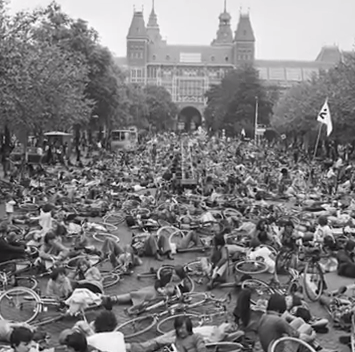
Mass cycling protest in Amsterdam
http://www.brainpickings.org/wp-content/uploads/2012/01/dutchbikes.png
The Netherlands is famous for its cycling infrastructure and policy. In light of climate change and the push to engage in more sustainable lifestyles, cities across the globe have been turning to the Dutch cycling model and trying to integrate its elements into their own sustainability/transport plans and policies. The Dutch cycling culture of today; however, is certainly different than it was in the past.
In the years after WWII, automobile usage skyrocketed following the rapid rebuilding of a war-torn country. Congestion of city streets and marginalization of cyclists quickly became apparent, but one of the most terrible effects of this shift towards automobile use was the number of accident-related deaths of children (400 in 1971) that occurred (1). Mass protests, notable the “Stop Child Murder” campaign became popular, and public pressure to create safer, more cycle and pedestrian friendly streets ensued. Finally, changes in policy and planning were generated at the government level with amazing results. Child deaths were significantly reduced, many city centers became car-free, and infrastructure changed dramatically to reflect the high priority of cyclists visible in Dutch cities today.
While I could write a whole other blog post on the successes (and failures) of learning from and implementing similar cycling models in other cities, I have chosen to highlight another lesson we should be reminded of from the Dutch experience.
The shift from the popularity of the automobile towards a more sustainable means of public transportation was achieved through protesting and public pressure on the government. What alarms me is that the main driver of these protests was the loss of life. It appears as though the 3,300 accident-related deaths in one year (1) was what it took for the public to finally rally together and effect change.
When I think about the heaps of changes that need to be made in our current lifestyles to live more sustainably, I wonder what it is going to take before we get that critical mass of people that can influence our government to help us make these changes on a large scale. There is an overwhelming amount of advocacy groups, initiatives and campaigns geared towards aspects of sustainable living – could any one of these be the next “Stop Child Murder” campaign and cause a great shift towards another element of sustainable living? It is my hope that we can be proactive, that we can stand behind movements to help them reach that critical mass, but that this can be done before we begin to see such severe, direct consequences such as loss of life. Let us learn not only from the fantastic example that the Dutch sets on sustainable transportation, but also from the way this change was effected.
Heather Stark

Saturday, June 1, 2013

My Carbon Cycle

The daily commute is something most people dread. Living in Glenageary and spending 5 days a week in college in the city centre, I spend approximately 90 minutes a day on buses (if I’m lucky and dodge the traffic!) which amounts to a whopper 450 minutes a week sitting on an over-crowded bus listening to other peoples music bleeding from their headphones. It’s time I loath to waste, but it’s not just time that I’m wasting.
My bus journeys make me accountable for about 20km of CO2 production weekly! Inspired by the clearing of the rainclouds and the signals that we may actually begin to experience something resembling Spring, I set myself what seemed like an achievable task: to forgo the buses for a week and instead cycle to college for the week. It seemed like a win/win situation: I’d be using a carbon neutral form of transport and I’d be saving on bus fare. “Why doesn’t everyone do this?” I asked myself as I set off on a crisp March Monday morning.
“Why doesn’t everyone do this?”

About an hour later, as I arrived panting into college, feeling like my legs were about to burst into flames, I found the answer to my own question: This is hard! Every tweak we make to our lives to make them more sustainable requires us making sacrifices.
I believe, in the developed world we are so accustomed to a plethora of amenities and indulgences which work their way into becoming part of our day-to-day lives. Removing even the smallest of these from your routine, is a huge shock to the system. It’s a change that can take a huge amount of adjustment to our daily routine and an element of sacrifice. Therefore, people living comfortable, perhaps financially sustainable lifestyles just simply can’t be bothered. Why go without when making a sacrifice which results in decreasing your carbon footprint puts extra strain or discomfort in your life when the benefits cannot be immediately seen?
It is an uphill battle that environmentalists face: convincing those so consumed with the present that they are directly contributing to the destruction of our future. The allure of immediate gratification is hard to compete with, however we must persevere and accept that seemingly small individual sacrifices now amount to huge collective benefit in the future.
This is a lesson I’ve heard many times, but only really rang true with me when I decided to make a personal sacrifice for the good of the environment in which I live. Taking the bus was by far the easier, passive option. But I had to ask myself, can I afford to knowingly be that selfish and not feel guilty? The answer was no. I’ve persevered with the cycling with some exceptions here and there (there’s no accounting for torrential downpour!) and have willingly made an achievable sacrifice for the greater good. Not to mention the bus fare I’m saving!
Stephen Lehane