This blog was originally based on a course ran by Professor Nick Gray of the Trinity Centre for the Environment at Trinity College Dublin who also wrote a textbook for the module Facing up to global warming: What is going on and what you can do about it. Now working as an independent consultant, Nick continues to work in the area of environmental sustainability and looking at ways of making a difference without recriminations or guilt. Saving the planet is all about living sustainably.


Showing posts with label Exercise. Show all posts

Friday, June 14, 2013

Learning from the Dutch cyclists – another important lesson

Learning from the Dutch cyclists – another important lesson
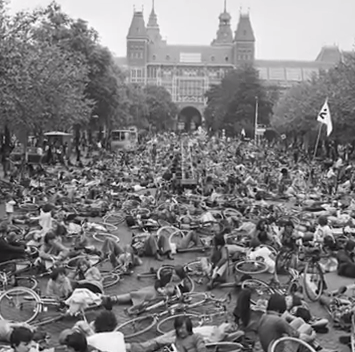
Mass cycling protest in Amsterdam
http://www.brainpickings.org/wp-content/uploads/2012/01/dutchbikes.png
The Netherlands is famous for its cycling infrastructure and policy. In light of climate change and the push to engage in more sustainable lifestyles, cities across the globe have been turning to the Dutch cycling model and trying to integrate its elements into their own sustainability/transport plans and policies. The Dutch cycling culture of today; however, is certainly different than it was in the past.
In the years after WWII, automobile usage skyrocketed following the rapid rebuilding of a war-torn country. Congestion of city streets and marginalization of cyclists quickly became apparent, but one of the most terrible effects of this shift towards automobile use was the number of accident-related deaths of children (400 in 1971) that occurred (1). Mass protests, notable the “Stop Child Murder” campaign became popular, and public pressure to create safer, more cycle and pedestrian friendly streets ensued. Finally, changes in policy and planning were generated at the government level with amazing results. Child deaths were significantly reduced, many city centers became car-free, and infrastructure changed dramatically to reflect the high priority of cyclists visible in Dutch cities today.
While I could write a whole other blog post on the successes (and failures) of learning from and implementing similar cycling models in other cities, I have chosen to highlight another lesson we should be reminded of from the Dutch experience.
The shift from the popularity of the automobile towards a more sustainable means of public transportation was achieved through protesting and public pressure on the government. What alarms me is that the main driver of these protests was the loss of life. It appears as though the 3,300 accident-related deaths in one year (1) was what it took for the public to finally rally together and effect change.
When I think about the heaps of changes that need to be made in our current lifestyles to live more sustainably, I wonder what it is going to take before we get that critical mass of people that can influence our government to help us make these changes on a large scale. There is an overwhelming amount of advocacy groups, initiatives and campaigns geared towards aspects of sustainable living – could any one of these be the next “Stop Child Murder” campaign and cause a great shift towards another element of sustainable living? It is my hope that we can be proactive, that we can stand behind movements to help them reach that critical mass, but that this can be done before we begin to see such severe, direct consequences such as loss of life. Let us learn not only from the fantastic example that the Dutch sets on sustainable transportation, but also from the way this change was effected.
Heather Stark

Saturday, June 1, 2013

My Carbon Cycle

The daily commute is something most people dread. Living in Glenageary and spending 5 days a week in college in the city centre, I spend approximately 90 minutes a day on buses (if I’m lucky and dodge the traffic!) which amounts to a whopper 450 minutes a week sitting on an over-crowded bus listening to other peoples music bleeding from their headphones. It’s time I loath to waste, but it’s not just time that I’m wasting.
My bus journeys make me accountable for about 20km of CO2 production weekly! Inspired by the clearing of the rainclouds and the signals that we may actually begin to experience something resembling Spring, I set myself what seemed like an achievable task: to forgo the buses for a week and instead cycle to college for the week. It seemed like a win/win situation: I’d be using a carbon neutral form of transport and I’d be saving on bus fare. “Why doesn’t everyone do this?” I asked myself as I set off on a crisp March Monday morning.
“Why doesn’t everyone do this?”

About an hour later, as I arrived panting into college, feeling like my legs were about to burst into flames, I found the answer to my own question: This is hard! Every tweak we make to our lives to make them more sustainable requires us making sacrifices.
I believe, in the developed world we are so accustomed to a plethora of amenities and indulgences which work their way into becoming part of our day-to-day lives. Removing even the smallest of these from your routine, is a huge shock to the system. It’s a change that can take a huge amount of adjustment to our daily routine and an element of sacrifice. Therefore, people living comfortable, perhaps financially sustainable lifestyles just simply can’t be bothered. Why go without when making a sacrifice which results in decreasing your carbon footprint puts extra strain or discomfort in your life when the benefits cannot be immediately seen?
It is an uphill battle that environmentalists face: convincing those so consumed with the present that they are directly contributing to the destruction of our future. The allure of immediate gratification is hard to compete with, however we must persevere and accept that seemingly small individual sacrifices now amount to huge collective benefit in the future.
This is a lesson I’ve heard many times, but only really rang true with me when I decided to make a personal sacrifice for the good of the environment in which I live. Taking the bus was by far the easier, passive option. But I had to ask myself, can I afford to knowingly be that selfish and not feel guilty? The answer was no. I’ve persevered with the cycling with some exceptions here and there (there’s no accounting for torrential downpour!) and have willingly made an achievable sacrifice for the greater good. Not to mention the bus fare I’m saving!
Stephen Lehane

Sunday, April 21, 2013

A Greener Trinity Ball?

Trinity Ball is clearly the most anticipated and famous night in our college calendar. With 7,000 students eagerly awaiting this prestigious event, the logistics and running of such an event are often forgot about. With all the hype, it is easy to forget about all the emissions caused by such an event. The hundreds of lights, world class sound systems and the five different stages all contribute to what can only be imagined as a rather large contribution to Trinity’s CO2 emissions. In this blog I will examine a number of eco-friendly festivals and see whether their initiatives could be implemented for the Trinity Ball.

World-renowned music festivals such as Glastonbury and Coachella have become famous, not only for the festival itself, but due to their ability to provide a rather eco-friendly and sustainable festival. They have both adopted a “no trace policy”, which ensures any waste generated at the festival is optimally recycled. Coachella has also become famous due to its solar powered DJ booths. At Portugal’s bi-annual Boom Festival where “biodiesel, solar and wind energy powered 25% of the festival, sustainable bamboo construction techniques literally took center stage” . However it is clear that these festivals are on a much, much larger scale than that of Trinity Ball.

So what could be done at Trinity Ball? Small and creative ideas can be implemented to help reduce its carbon footprint. Something that I feel could be easily implemented is that off providing only organic food produce at the number of food stands. Another idea that could be introduced is one that is similar to what was in place at the former Oxegen music festival. There aim was to reduce the amount of plastic cups that were used at the festival. A pint of beer at Trinity Ball costs 5 euro. My suggestion would be to charge the five-euro for your first pint, and if you return with the same plastic cup, your next pint would see maybe a euro reduction in the price. This would encourage people to keep their plastic cups rather than flinging them on to the ground. This would, I feel, have a significant impact on the amount of waste reduced. Changing the energy sources to a more eco-friendly source would also be a viable option available to the organisers of Trinity Ball. Even something as simple as a pledge by the organisers to ensure that all of the waste is taken care of with the highest diligence is something that would make for a greener festival.

Even small steps towards a greener ball will be something that would be met with great enthusiasm not only by the organisers but also by the college as a whole. If anyone has any other suggestions, big or small, feel free to leave them in the comments section.

Kevin Mateer

Sunday, February 24, 2013

Eco Gyms - Generating Your Own Electricity?


A photo of The Green Microgym in Portland, Oregon.
(image from: http://www.thegreenmicrogym.com)

The other day I was working out at my gym and I looked around at the rows of people moving along to the rhythms of their various ellipticals, treadmills, cycles, and stair masters, their store-purchased water bottles perched atop the blinking electronic dashes of their machines; I took note of the row of large televisions that constantly blare at the front of the room; I thought about the lights turned up bright, despite the sunlight flooding in through the wall of windows; and I thought: “This seems wrong!” I was surrounded by consumption and wasted energy. All of the cardio machines, TV sets, fans, stereos and lights in this gym are plugged in and running all day long from open till close. Fitness centers, particularly in the United States (my home country) use an extraordinary amount of energy and water. Treadmills alone require about 1500 watts of energy to power and most machines and equipment in gyms are left on all day long (1).Stationary bikes lose about 90% of the energy they use in heat while only 10% is used to actually power the machine (2).  The gym would appear to be the ultimate antithesis of an environmentally friendly institution. It seems silly to be on machines that are reproducing motions that our bodies should be able to do on their own. Our lifestyles should, in theory, be supporting our health, right? We should be out in nature, running and walking and cycling and lifting every day items and we should all be in perfect shape. Gyms, in a perfect world, should be entirely unnecessary. But that is not how it works. We are endlessly confronted with the paradox of the developed world’s endless struggle with fitness. None of us are strangers to the epidemic of obesity that struck America and moved its way over to Ireland (and in a big way, might I add!)

Our world cannot become sustainable if the health our population is slowly deteriorating into a big lump of overweight consumers. Many gym enthusiasts will never give up their memberships in exchange for a jog outside, and many unfit or unhealthy individuals may have to rely on a gym as a way to find support and assistance in their efforts to become healthier.

So, are gyms just a necessary evil that will go on producing emissions at remarkably rapid rates, and we should just turn our heads the other way? It doesn’t seem so entirely hopeless! I started doing some research into the topic of sustainability in gyms and quickly found that I am not the only person who is troubled by the vast amount of water and energy wasted by gyms, particularly in the US. There is a wealth of information about the inefficiency of gyms and health centers, but there is also an incredibly interesting new trend of what are called eco gyms. Eco gyms operate on the idea that they can capture the energy that is expended while working out and use it to power their facilities, in theory rendering the building self-sustaining. Like gerbils spinning around a wheel, humans in a gym are in essence doing little else beyond producing energy in the form of burning calories. One of the many gyms that I read about was from Portland, Oregon (my hometown!) and uses incredibly low levels of energy by using specially designed machines that are and hooked up to DC generators that produce energy to power the facility (3). The gym also uses refurbished and sustainably manufactured equipment (even mountain bikes made of bamboo!) and the bathrooms use special water heaters and eco-friendly cleaning products. Eco gyms are becoming increasingly popular around the globe (4). They also include lower levels of lighting, relying more on natural light, more eco-friendly water usage, and sustainable cafes in their lobbies. There are, of course many problems, such as the high costs of “greening” an already existing facility, and the fact that many gyms are too small to actually produce enough energy to run their own machines, but these ideas seem incredibly helpful in moving the fitness industry in the right direction (5).  Of course, the only real way to eliminate emissions issues with gym facilities would be to move everyone’s workouts outside, but it would be great to see more facilities at least attempting to institute some of these practices or even for cities to start adding incentives for companies to do so so that our health and environment can become more sustainable. Some of these products, such as cardio equipment that captures and stores usable energy could even be useful in the home, producing power to fuel your ipods and cell phone chargers. You could offset your own footprint to some extent with your own human watts! I love the gym, but I am going to be more conscientious and start taking my workouts outside whenever the weather permits.

Katie Gourley