This blog was originally based on a course ran by Professor Nick Gray of the Trinity Centre for the Environment at Trinity College Dublin who also wrote a textbook for the module Facing up to global warming: What is going on and what you can do about it. Now working as an independent consultant, Nick continues to work in the area of environmental sustainability and looking at ways of making a difference without recriminations or guilt. Saving the planet is all about living sustainably.


Showing posts with label Trinity Centre for the Environment. Show all posts

Saturday, December 5, 2015

Action Day at COP21 - Today everyone is invited to start taking action to control global warming


Today is Action Day at COP21 in Paris.  Today everyone is invited to start taking action to control global warming. http://bit.ly/1TrKg2F http://bit.ly/1lCjXMi

Our book Facing up to Global Warming: What is Going on and How You Can Make a Difference? published by Springer and launched for COP21 by Professor Nick Gray of the Trinity Centre for the Environment explores what global warming is, how it affects climate and importantly how we can deal with.  It is a challenge that everyone needs to be a part of. So on this day of action make a pledge to do your part to reduce greenhouse gas emissions by examining how you can minimize waste without compromising how you want to live. 

Twitter @Nickgraytcd

Friday, December 4, 2015

Follow COP21 live


This year the UN climate talks (COP21) are taking place in Paris from the 30th November to 11th December. The aim is to achieve a legally binding and universal agreement on climate with the aim of keeping global warming below 2 degrees C. There will be an estimated 50,000 participants including 25,000 official delegates. For those attending the aim is to stimulate interactions during the conference between the negotiators and representatives of Civil Society. Of course the remaining 7 billion of us won't be able to attend the conference, but thanks to the UN we will be able to follow the conference live at  http://unfccc6.meta-fusion.com/cop21/


More information of global warming and climate change http://bit.ly/1NPLbun


Posted Nick Gray

Friday, October 16, 2015

World Food Day


Today is World Food Day which highlights the urgent issue of chronic hunger and promotes positive action through events in some 150 countries.  Follow the action on the web or  on Twitter

About 795 million people are undernourished globally, down 167 million over the last decade, and 216 million less than in 1990–92. The decline is more pronounced in developing regions, despite significant population growth. In recent years, progress has been hindered by slower and less inclusive economic growth as well as political instability in some developing regions, such as Central Africa and western Asia.

Read more in the latest FAO Report The State of Food Insecurity in the World


Posted : Nick Gray https://twitter.com/Nickgraytcd

Thursday, September 24, 2015

Facing Up To Global Warming Published

Facing Up To Global Warming: what is going on and how you can make a difference?


This new book was published today and  explores climate change and how individuals can make a difference. 

 Below is the Preface from the new book.


In 1972, a startling book was published called Limits to Growth . This book became hugely influential in the environmental movement, and while it alerted us to the fragility of our future on planet Earth, it also, inadvertently, helped to eventually undermine the credibility of environmentalism. The book predicted when certain non-renewables, including fossil fuels and metals, would become exhausted. The predictions were based on the best available knowledge at that time, but what it never envisaged in the early 1970’s, was that within a decade humans would be extracting oil, gas, and minerals in some of the remotest, extreme, and fragile places on Earth … a process that has continued and expanded to the present day. So the predictions proved incorrect in practice, but it reinforced the idea that all resources are limited and are slowly being exhausted.

This book became a driving force for many environmental scientists who realized that we have to act both collectively and individually to preserve our home, planet Earth, with its unique biosphere and which is home to millions of different living organisms of which we are just one species. For me personally, being an environmental scientist has been a long and often disappointing journey and at various times I have been shocked, scared, and often depressed by the unfolding of the current crisis which is so intertwined with global warming. But, to my surprise, in recent years I have begun to feel more hopeful that perhaps we can deal with our climate and resource problems to create a sustainable planet. So in this book, I have attempted to explain what the problems are and suggest some solutions. However, the book comes with a warning. During the 15 chapters that follow, I am going to make a lot of you really annoyed and possibly upset, I apologize in advance. I am not trying to shock; I am simply putting the facts before you so that you can make up your own mind. Neither am I telling anyone that their lifestyle is wrong, or alternatively, that they are better than the next person because they have invested in green energy or a hybrid car. The book is an overview; it is not a text on the theory of sustainability or population dynamics; it simply looks at what the individual should know and addresses some of the issues closest to our everyday lives.

There are hundreds of academic and specialist texts on sustainability, but they fail to link sustainability to tackling global warming, especially at the individual level. Adopting any form of sustainable actions in your life will cause significant effects both direct and indirect. Such actions will lead to changes that will influence economic and social norms … so sustainability if properly applied will mean socio economic change. I begin the text by giving a brief overview of the problems of climate change and the real difficulties that having such a rapidly growing population is placing on the idea of a sustainable and equitable planet. Discussions on population is always a very emotive issue and so I have simply given some basic facts, and shown that as population grows our ability to live sustainably on planet Earth becomes more challenging. So this is not a comfortable book.

Is the text political? I have tried not to be, but if you advocate changing people’s lifestyles, then it will appear to be political. Then, we have the concept that everyone on the planet matters and that the concept of global justice and human rights is important when assessing the sustainability of our own lifestyles. So trying to avert these climate-mediated crises by ensuring that everyone has enough for their needs without being wasteful is a good starting point. However, that starting point has to be an acknowledgment that all people are equal, and that we should all have the right to pursue happiness and well-being. Is this naïve? Of course it is, but what else are we to strive for in a truly global and fair society. Global warming raises serious social as well as economic questions and many of these are going to be very difficult to deal with in practice, and my aim is to try and make you think about these issues from a personal perspective. Can we have finite economic growth? Can we have finite consumerism? Unfortunately, the answer has to be no to both of these questions, which means that both economists and social geographers or planners have a lot of work to do and that we are going to have to eventually reinvent our economy and social environment to achieve these goals.

There are also many other important environmental issues that we also need to consider and many of these are also linked to global warming such as deforestation, exploitation of new fossil fuel reserves, intensification of agriculture, and overexploitation of water resources. However, many of these issues such as pollution, are less important in the context of global warming, as we now have them largely under control. We have made huge strides in dealing with air, water, and land pollution over the past 40 years, and there are scientists and regulatory bodies all dealing with these issues on an on-going basis. Such issues are predominately local or at worst regional, but rarely global, and what is important is that we have the technology and infrastructure to deal with them. But controlling carbon dioxide and other greenhouse gas emissions must now be everyone’s priority. If we have to reduce carbon emissions by 80 % by 2050 to avert a global crisis, this will mean using significantly less energy in the developed world than we currently use, and while this does not necessarily mean an immediate and huge change in our everyday lives, it does mean changes to our current lifestyles. This is not going to be easy and the burden has to be shared by everyone. However, the fact is that people feel very threatened by the idea of altering their lifestyle, even when change can be for the better. 

We also need to understand that some sectors of society are using more than their fair share of global resources, but that in the context of global warming everyone must act responsibly if we are to succeed in mitigating climate change. Those in developing countries also desire the technology, food, travel, etc. we enjoy, and to break this cycle we in the developed world need to begin to pull back from our current high-energy lifestyle while allowing the poorer nations to develop and become sustainable.

This book will never be welcomed by those who are pretty happy with the status quo and who have not become genuinely concerned, possibly scared, by the possibility of what global warming may do to our home, planet Earth. This is a very general text that looks at different aspects of our lives which we, as individuals, have control over. It is simple things like travel, food, recycling, using resources … all those things which we are all involved in on a daily basis; and how our actions affect the future of planet Earth and our ability to sustain that ever growing human population. I hope that this book will help you think and act from a position of knowledge and reassurance.

I hope that the majority of you will be reassured that we are beginning to tackle global warming successfully, but in order to succeed in stabilizing our new climate, and I believe we can, we need your help through direct action. You really can make a difference. This book is a personal journey and during it I will be asking you to do various things. Some are critical others will be just things that I hope you will try, but to work, I need a commitment from you. The journey is not free, it comes at a cost, and you have to decide just how much you are willing to pay for your planet.


This is about your future.
Nick Gray
Trinity Centre for the Environment

Thursday, August 13, 2015

Today is Earth #Overshoot Day


This year Earth #Overshoot Day falls on  August 13th...today.  This is when we have used up all our natural capacity.

Find out more and act on climate change...it is what you do that makes the difference and makes tackling global warming possible.  For help in doing this go to 


Posted: Nick Gray

Tuesday, August 4, 2015

Real time wildfire mapping in the United States


Although we are all watching the current wildfires in California, a more serious situation is occurring in Alaska with thousands of hectares currently affected. 

The Geospatial Multi-Agency Co-ordination Group provides real time mapping of current wildfires throughout the United States.  Zoom onto the flame showing a wildfire for its perimeter and then click for full details of the size of the fire, exact location and the extent to which it has grown or shrunk over the past 24 hours and also details of how much has been contained.  With high temperatures and less rainfall this is the worst season for wildfires to date.

Posted: Nick Gray


Sunday, July 26, 2015

How do climate scientists really feel about global warming!


This remarkable video explores how Australia’s top climate scientists personally feel about global warming induced climate change.  They were asked t respond to the question, “How does climate change make you feel?” by Joe Duggan who has compiled their handwritten responses in an exhibition to be shown in August.


posted: Nick Gray

Thursday, July 16, 2015

Germany achieves new energy generation from renewable levels

Germany is making enormous strides in developing its use of renewables for energy generation which reached 23.4% in 2014,and being one of the few countries to have a geothermal power station.  For a full breakdown and analysis visit

Nick Gray 


Sunday, July 12, 2015

Trash is for Tossers: say NO to trash

‘Trash is for Tossers (say NO to trash)’ is the blog of  Lauren Singer who is trying to live a zero waste life in the heart of New York City.  She is sharing her journey towards this excellent goal, although I suspect it is going to be a tough one. She has one great quote ‘I really decided that I not only needed to claim to love the environment, but actually live like I love the environment’.  She also gives two really interesting and helpful definitions:

Waste …’a  point source, meaning it is discarded by its holder with intent of it going to landfill. Trash is anything a person plans to throw away or anything a person deems obsolete that is then discarded in a manner where it will not be intended for re-purposing or reuse even if it unknowingly will be at some point in the future. ‘

Zero Waste means that I do not produce any garbage. No sending anything to landfill, no throwing anything in a trash can, nothing. However, I do recycle and I do compost. 

Lauren is really on the right path here and I for one will be following her journey and learn from her experiences.

@Trashis4Tossers

Nick Gray 
@nickgraytcd

Saturday, July 11, 2015

World Population Day


On the 11th July 1987 the global population reached 5 billion and to mark this important milestone the United Nations decided to designate this day each year as World Population Day.  On this day organizations around the world raise awareness of our growing population and the issues that surround a rapidly growing population.  But is also about celebrating our achievements as well as bringing to our attention the plight of groups of people around the world.  The theme this year is raising the awareness of vulnerable woman and children in emergencies. More information

Nick Gray
@nickgraytcd


Tuesday, June 2, 2015

Peak Water...Is Water a Renewable Resource?

Peak Water...Is water a renewable Resource?
Peak water is reached when the rate of water demand exceeds the rate at which water resources used for supply can be replenished. Therefore, all water supplies can be considered finite as they can all be depleted by over exploitation.  So while the total volume of water in the hydrological cycle remains the same, the availability of water does alter.  This is particularly true of aquifers (groundwater) and static water bodies such as lakes and reservoirs where the water may take a long time to replenish. So water availability is strongly linked to rainfall and the ability to retain this water within resources which is difficult as increasing intensity of water reduces infiltration.

Due to increasing demand from population growth, migration to urban centres and for agriculture, it is possible that a state of peak water could be reached in many areas if present trends continue.  By 2025 it is estimated that 1.8 billion people will be living with absolute water scarcity and in excess of 4 billion of the world’s population may be subject to water stress.  


A question I am often asked is how does a renewable resource become finite?  The answer is not as straight forward as first appears.  Water availability is governed by a number of possible factors: Over-abstraction  (i.e. using it before it can be replenish thereby exhausting the supply and causing significant and often permanent ecological damage), not returning water to hydrological resources, saltwater intrusion often caused by over-abstraction, pollution  of resources and finally climate change effects (glacier loss, reduced stream flow, evaporation of lakes).  Comparatively only a very small amount of water is regularly renewed by rain and snowfall, resulting in only a small volume of water available on a sustainable basis.  So all water supplies have an optimal abstraction rate to ensure they are sustainable, but once exceeded then supplies are doomed to failure.  As we saw in Section 3.2, a modified Hubbert curve applies to any resource that can be harvested faster than it can be replaced. This applies to all water resources but especially to groundwaters.

Peak water is defined in three different ways according to the impact on the resource as:  peak renewable, peak non-renewable or peak ecological water.

Peak Renewable Water comes from resources that are quickly replenished such as rivers and streams, shallow aquifers that recharge relatively quickly and rainwater systems.  These resources are constantly renewed by rainfall or snow melt; however this does not mean these resources can provide unlimited supplies of water.   If demand exceeds 100% of the renewable supply then the “peak renewable” limit is reached.  For many major river catchments globally, the peak renewable water limit has been reached.  For example, in excess of 100% of the average flow of the Colorado River is already allocated through legal agreements with the seven US States and Mexico. So in a typical year the river flow can now fall to zero before it reaches the sea.  Similarly the River Thames can during periods of low flow fall below the volume of water abstracted.  The river is prevented from drying up due to over-abstraction by returning wastewater after treatment to the river which is then reused numerous times as it approaches London. Due to the high population within the catchment, the Environment Agency has classified the area as seriously water stressed with towns and cities along the length of the Thames such as Swindon, Oxford and London itself, at risk of water shortages and restrictions during periods of dry weather.

Peak Non-renewable Water  comes from resources that are effectively non-renewable aquifers that have  very slow recharge rates , or contain ancient water that was captured and stored  hundreds or thousands of years ago  and is no longer being recharged ( a problem that will be exacerbated by climate change), or groundwater systems that have been damaged by compaction or other physical changes.

Abstraction in excess of natural recharge rates becomes increasingly difficult and expensive as the water table drops which results in a peak of production, followed by diminishing abstraction rates and accompanied by a rapid decline in quality as deeper more mineralized waters (i.e. increasingly salty to the taste) are accessed. Worldwide, a significant fraction of current agricultural production depends on non-renewable groundwater (e.g. North China plains, India, Ogallala Aquifer in the Great Plains of the United States) and the loss of these through over-exploitation threatens the reliability of long-term food supplies in these regions.

When the use of water from a groundwater aquifer far exceeds natural recharge rates, this stock of groundwater will be depleted or fall to a level where the cost of extraction exceeds the value of the water when used, very much like oil fields. The problem is that climate change often results in less rainfall creating a greater dependence on aquifers for supply.

Peak Ecological Water is water abstracted for human use which leads to ecological damage greater than the value of the water to humans. The human population already uses almost 50% of all renewable and accessible freshwater leading to serious ecological effects to both freshwater resources and transitional habitats such as wetlands.  Since 1900, half of the world’s wetlands have disappeared while approximately 50% of freshwater species have become extinct since 1970, faster than the decline of species either on land or in the sea. Water supports both man’s need and that of its natural flora and fauna.  These fragile environments need to be preserved for overall planet health. The simple fact that water supply quality is often a close relationship with the ecosystem, with most water bodies able to self purify its water constantly removing pollutants and improving quality overall. However, the problem has been in putting an economic value on ecological systems (sometimes referred to as ecological services) and nature as a whole; whereas water used by humans can be easily quantified economically.  In the mistaken assumption that such values are zero has led to them being highly discounted, underappreciated, or ignored in water policy decisions in many areas.   Over-abstraction is a major problem in many rivers in southern England that are fed from the aquifer below.  As more groundwater is abstracted then the water table falls as does the water level in the river.

 It is not only rivers that are drying up due to over abstraction and global warming but some of the largest freshwater lakes in the world such as the Aryl Sea and Lakes Chad and Victoria in Africa. Link   In the USA, water abstraction and water use peaked during 1975 to 1980 but has stabilized since.  This should have affected economic growth but has been able to continue  to grow by implementing better water management strategies to satisfy the new needs of industry.  This has been achieved through water conservation, stricter regulations, water efficient and improved technology, education, water pricing etc.  So US citizens are now using less water per capita than ever before.   However, many regions of the U.S. face water scarcity (e.g. the arid west) and new areas of water scarcity continue to develop due to climate change (e.g. southeast and Great Lakes region) which all indicate that peak water has been reached . The key question is how long can economic growth be sustained without water becoming a limiting factor? More information.

Will water shortages affect us in Ireland and the UK?  The straight answer is yes, and to some extent already is.  No one is exempt from the peak water crisis.  Due to global warming most arid regions will probably run out of water in less than two decades.  In wetter areas, peak water has been reached due to: heavy use of water; pollution of resources (often associated with urbanization); infrastructure not being completed to keep up with demand (China, India) and finally inadequate infrastructure (London, Dublin).

Agriculture represents at least 70% of freshwater use worldwide and with the demand for food soaring, especially as a result of climate change and increasing crop failure (e.g. China rice failure in 2011) then demand for irrigation and livestock watering will continue to be a major drain on supplies 


Extract from: Gray, N.F. (2015) Facing up to Global Warming: What is Going on and How You Can Make a Difference, Springer, New York. 
@nickgraytcd

Thursday, June 26, 2014

Glaring signs of active desertification and the hopeful yet strategic words of a wise man

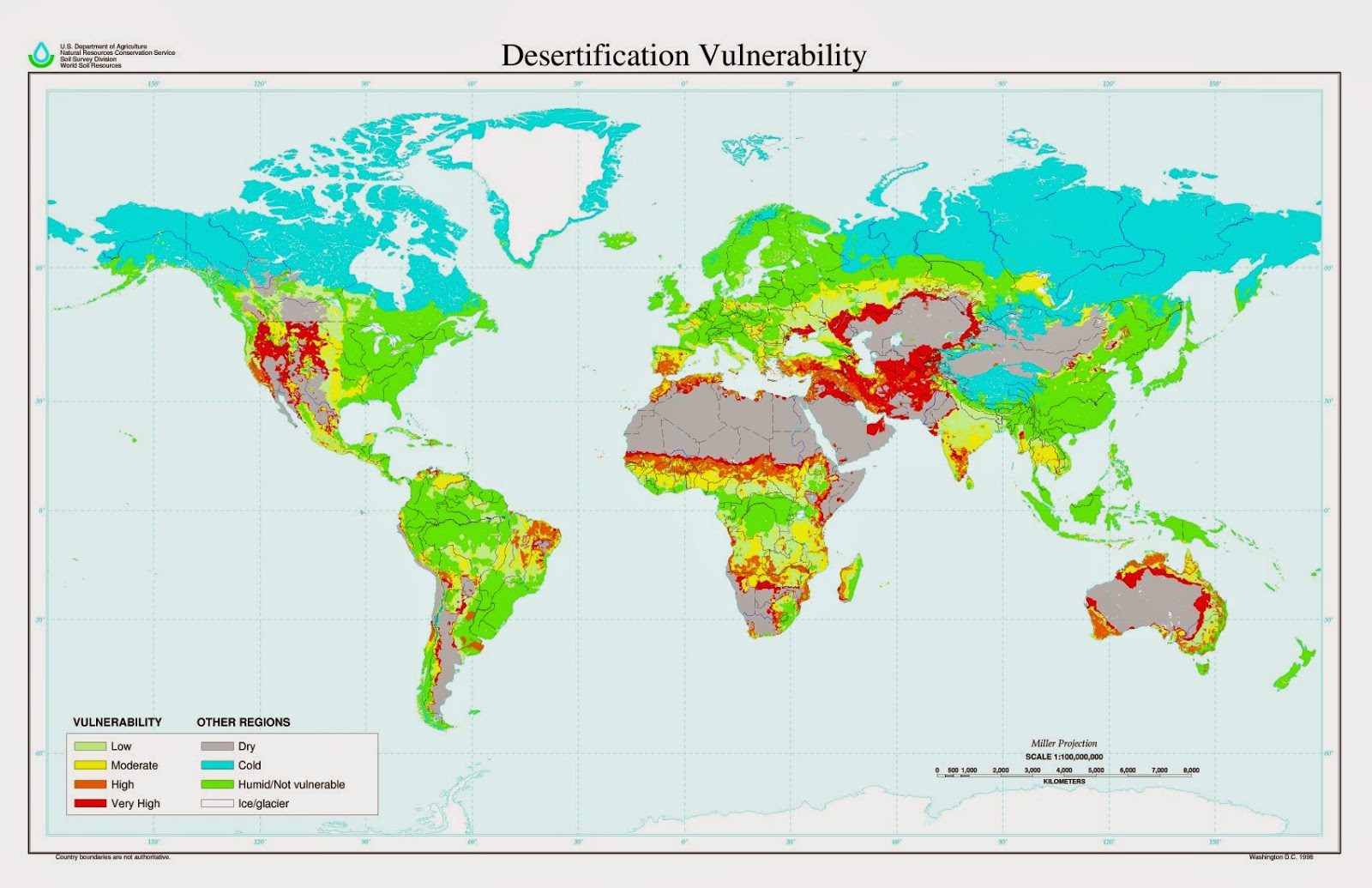
A recent report entitled UN report: one-third of worlds food wasted annually, at great economic, environmental cost sparked in me a concern over land usage and destruction caused by our very own food wastage. Our wasted food accounts for a staggering 28% of the worlds agricultural area or 1.4billion hectares.  All of which ends up in our bin. The article discusses a recent report published by the FAO on our Food Wastage Footprint. With the drastic spreading of desertification, we simply cannot afford to allow 28% of our fertile land produce to be thrown in the garbage. As the diagram below indicates, areas surrounding now desert land (marked in red) are at high risk of desertification, these areas often belong to small countries who are highly dependent on their agricultural use and whose desertification will only cause a ripple effect of increased dependence and indebtedness on agricultural land belonging to more economically wealthy countries.
Copyright: http://upload.wikimedia.org/wikipedia/commons/6/68/Desertification_map.png


The results of a study undertaken by A. Challinor in 2010 suggests that for China, climate change will result in increasing spring wheat crop failure in northeast China due to increasing extremes of both heat and water stress. Now according to this quotation, that study correlates with the image above, where North-east China is at high risk of desertification. There has also been a lot of coverage on rice crop failures in China and the millions of tonnes of GHGs released as a result of this. Although there are ideas being developed to create heat-resistant and drought-resistant crops, the real answer is right in front of us and within reach. Following the FAO report cited earlier, the FAO provided a free toolkit on reducing our food wastage footprint.

Copyright: http://www.rmaf.org.ph/userfiles/
images/profile_pictures/F/fukuoka.jpeg

Another view of desertification which I would like to touch on is that of Masanobu Fukuoka. I recently read a book of his, One Straw Revolution which spoke of his system of natural farming where crops could be grown without plowing his fields, using no prepared fertilisers or agricultural chemicals and did not flood his rice fields as farmers in Asia continue to do. A method which he himself developed and lived by for over 65years and in fact yielded greater quantities of crops than the most productive farms in Japan. This book is highly relevant to the individual and although delves into some technicality, Fukuokas book serves a far greater purpose than farming methods. However it is his second and last book which I find so relevant to this topic of desertification, called Sowing Seeds in the Desert. Although Fukuokas influence has been only marginal so far, the increased rate of desertification begs us to look at alternative possibilities, which include a return to simple but effective methods of farming. Fukuoka reminds us that the present state of our land is not natural but rather a result of our own destructive actions, his silver-longing however, is it can be remedied and perhaps eventually reversed. HIs aspiration was to achieve global food security by natural farming which he practiced and preached in Africa, India, Southeast Asia, Europe and the United States.  Fukuoka offers us an opportunity to put aside our guilt as we face this earths degradation and take a step forward in the right direction.

Una Quinn